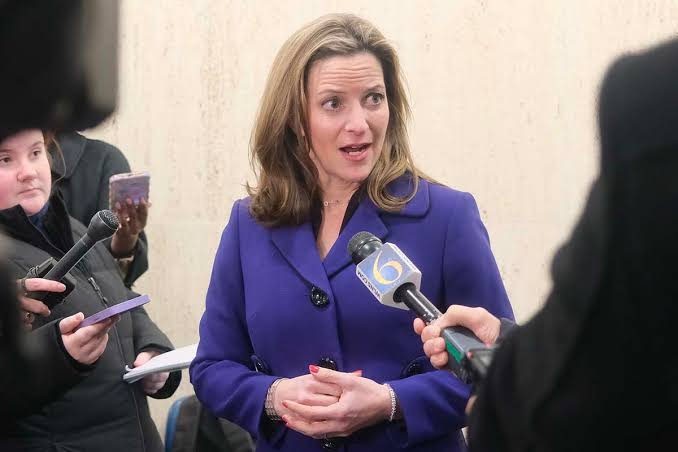
Michigan Secretary of State Jocelyn Benson faces a court challenge over election-record deletion requirements that a township clerk argues violate federal preservation law.
Five years after Michigan officials removed an elected township clerk who challenged their instructions, another clerk has taken those same officials to court. The controversy exposes a growing conflict over who controls Michigan’s elections and what happens when local officials challenge the state.
HILLSDALE COUNTY, MICHIGAN | October 28, 2026
Five years ago, Michigan officials stripped an elected Hillsdale County clerk of her election duties after she challenged the state’s instructions. They later pursued felony charges against her over the handling of election data.
Now another township clerk has taken those same election administrators to court, challenging their authority to order the deletion of electronic election records.
The first clerk was Stephanie Scott. The second is Michelle McQueer.
McQueer’s attorney, Kevin Kijewski, described the conflict between Michigan’s deletion rule and federal preservation law in a court filing reported by The Midwesterner:
“Obey the rule and she risks federal penalties; obey the statute and she violates the rule.”
On October 27, Kijewski announced that a Michigan Court of Claims judge had ordered Secretary of State Jocelyn Benson to instruct local election officials statewide to preserve electronic poll books from the upcoming November 3 election, temporarily preventing enforcement of the state’s deletion rule.
The reported order expanded upon the court’s October 5 decision, which had protected McQueer’s earlier records but declined statewide relief. The October 27 order has been publicly quoted by counsel, although its signed text has not yet been independently examined for this article.
What began in Hillsdale County as a confrontation between an elected clerk and Michigan’s election bureaucracy has become part of a statewide legal battle drawing national political organizations and the federal government.
And buried within the criminal prosecution of Stephanie Scott is something that makes the connection especially revealing:
Sworn testimony from the state’s own election officials documenting the deletion of electronic election records and questions about the authority they exercised against her.
When a Township Clerk Challenged Lansing
In 2021, following the contested 2020 presidential election, Adams Township Clerk Stephanie Scott questioned instructions from Michigan’s Bureau of Elections to remove electronic election files and perform maintenance on election equipment.
Her concerns centered on preserving election evidence under her custody. Under both 52 U.S.C. § 20701 and MCL 168.811, election officers must retain ALL records associated with state and federal elections for 22 months.
Michigan Elections Director Jonathan Brater responded on October 25, 2021, by prohibiting Scott from administering the upcoming township election. County officials intervened, and Michigan State Police subsequently executed a search warrant at Adams Township Hall.
As The Hillsdale Collegian reported in November 2021, township officials disputed suggestions that election equipment had disappeared, maintaining that it remained secured at the township hall.
Scott had been elected by the residents of Adams Township, not appointed by Brater or Benson. Yet a state administrator had effectively displaced her from performing her election duties.
Four years later, during his August 11, 2025 sworn testimony, page 97, Brater was asked whether any statute or administrative rule expressly authorized him to prohibit Scott from performing the duties of her elected office.
His answer:
“No, the election law does not expressly say that.”
Brater maintained that his actions were authorized by the state’s general supervisory powers, despite acknowledging that the election law did not expressly provide for the prohibition he imposed.
The confrontation eventually escalated into a criminal prosecution.
In May 2024, Attorney General Dana Nessel’s office announced charges against Scott and attorney Stefanie Lambert Junttila involving alleged unauthorized access to election information, computer offenses, conspiracy, and misconduct in office. Scott also faced a misdemeanor allegation concerning disobedience of an election instruction.
The charges concerned the handling and disclosure of election information, rather than simply refusing to delete electronic poll books, but arose from the prolonged conflict over Scott’s responsibilities and control of election materials.
As the Hillsdale Daily News and Hillsdale County Review covered the proceedings, Scott faced the possibility of imprisonment.
For other elected township clerks, the consequences were impossible to overlook.
Challenge the state’s authority, and you could find yourself in Stephanie Scott’s position.
What the State’s Own Witnesses Revealed
During Scott’s criminal proceedings in August 2025, the defense questioned the very officials involved in the original confrontation.
Hillsdale County Clerk Abraham Dane, who had served as chief deputy clerk in 2021, was confronted with a February 2021 exchange in which Scott warned that following the Bureau’s instructions could destroy potential election evidence.
Dane had responded:
“You have a point there. I won’t disagree.”
The exchange appears on page 61 of Dane’s certified testimony. Dane explained that he was acknowledging the controversy surrounding the election rather than conceding that the instructions were unlawful.
The questioning then turned to his own handling of electronic poll-book records.
Dane acknowledged that EPB flash drives contained election information and that, once the original files were deleted, they could no longer be independently compared against the printed election reports.
When defense attorney Kurt Olsen asked whether Dane had personally deleted EPB flash-card data since 2020, he answered:
“Many times.”
August 12, 2025 certified testimony, page 63.
Dane also acknowledged taking possession of Adams Township’s November 2020 ballots. When asked whether he could identify a statute specifically authorizing him to take them, he answered:
“No.”
August 12 certified testimony, page 144.
Brater provided another significant admission. When questioned about the Bureau’s original electronic poll-book deletion directive, he acknowledged that it:
“was not promulgated as a rule under the Administrative Procedures Act.”
August 11, 2025 certified testimony, page 50.
The Bureau had issued deletion instructions for years before Michigan formally adopted Administrative Rule R 168.48 on October 23, 2025.
These admissions were examined in Hillsdale Press’s investigation, Deleted from History, and The Hillsdalian’s reporting on Brater’s testimony.
On April 30, 2026, Circuit Judge Sara Lisznyai dismissed the felony charges against Scott and Lambert, finding that the lower court had committed an error of law and abused its discretion in binding them over for trial under the prosecution’s interpretation of Michigan law.
A misdemeanor allegation remained for further proceedings, and Nessel appealed the felony dismissal on July 24.
The testimony had emerged not from a voluntary public accounting of election-administration practices, but from the state’s prosecution of the clerk who questioned its instructions.
When Clerk Shortages Became a Justification for Expanding Authority
While Scott fought the state in court, another problem was developing across Michigan.
Township clerk positions were becoming increasingly difficult to fill. Election responsibilities had expanded, compensation often remained low, and officials faced growing workloads, public hostility, and political pressure.
An October 19 investigation by Bridge Michigan reported nearly 500 local races without enough candidates to fill available positions. A University of Michigan survey also found that more than three-quarters of townships and villages were experiencing greater difficulty filling mandatory elected offices.
Scott’s experience demonstrated another risk of challenging state election instructions: government intervention and the possibility of criminal prosecution.
The documented shortages had multiple causes, but the treatment of dissenting clerks formed part of the broader conflict between local election officials and Lansing’s administrative demands.
By March 2026, those shortages had become the justification for legislation expanding the use of outside election administrators.
State Representative Jennifer Wortz, joined by Representative Jay DeBoyer, introduced House Bill 5717, proposing to amend MCL 168.373.
Existing law required township boards to appoint qualified registered electors of their own townships when clerks and deputies were unavailable.
HB 5717 would authorize contracting with accredited election administrators from outside those communities under specified circumstances.
On March 17, Hillsdale County Clerk Abraham Dane testified in support of the bill.
The proposal addressed an identifiable staffing problem, but it also would have changed a longstanding limitation on who could administer township elections.
And in Hillsdale County, arrangements resembling the proposed authority were already underway.
Fayette Township’s clerk position was vacant before its May 5 special election. Litchfield City Clerk Cassidy Taylor, who was not a registered elector of Fayette Township, performed election-administration functions.
Stephanie Scott challenged that arrangement under MCL 168.373.
The dispute, supporting records, and questions raised during the county canvass were examined in Hillsdale Press’s investigation, They Knew.
On May 21, HB 5717 passed the Michigan House 104–2. Only Representatives Steve Carra and James DeSana voted against it.
In his voting explanation, Carra warned that the proposal:
“opens the door to centralizing our elections in a dangerous way.”
The bill reached the Senate on June 2, where it remained in the Elections and Ethics Committee without further action as of October 28.
Hillsdale County nevertheless continued pursuing outside arrangements. On July 28, county commissioners approved an election-services agreement involving Moscow Township, prompting additional objections over statutory authority. Those events were documented in When Government Acts Without Authority.
Neither House passage nor a pending Senate bill changed the existing law.
The proposed expansion followed years of increasingly demanding election administration, public conflict, and difficulty recruiting local clerks. It also followed the state’s intervention against Stephanie Scott, whose case demonstrated the consequences an elected official could face for challenging Lansing.
Were the difficulties confronting local clerks becoming the justification for transferring more election authority away from the very communities those clerks represented?
Jennifer Wortz’s Changing Public Message
After HB 5717 stalled in the Senate, Wortz became increasingly outspoken about another issue involving the Michigan Bureau of Elections.
On April 22, she had introduced House Bill 5845, proposing that electronic poll-book flash-drive data be preserved for 22 months. The House passed it in June, but it too remained pending in the Senate.
Then, on August 19, Wortz issued a public statement condemning the Bureau’s seven-day deletion requirement.
She called the requirement:
“completely backwards and obviously illegal.”
Wortz also declared:
“Election records belong to the people, regardless of which party wins or loses.”
Her statement specifically referenced Michelle McQueer’s lawsuit and argued that the Legislature, rather than administrative regulation, should establish the requirements for preserving election evidence.
Wortz had supported record preservation before HB 5717 stalled, but her August statement brought the conflict over the Bureau’s administrative authority into sharper public focus.
The contrast was striking.
The same representative who had championed broader use of outside accredited election administrators was now criticizing the Bureau for imposing a deletion rule she considered unlawful.
More significantly, the preservation concerns she publicly defended in August closely resembled those Stephanie Scott had raised years earlier.
Why had Scott spent years facing government intervention and prosecution following her challenges to election instructions, while preserving those same types of records was now being defended by legislators and pursued in court?
From Hillsdale County to a National Election-Security Controversy
Filed on August 12, 2026, McQueer v. Benson, Case No. 26-000172-MZ, challenges Michigan’s requirement that electronic poll-book software and associated files be deleted shortly after election certification, subject to specified exceptions.
The state maintains that federally required information is preserved in printed reports and uploads to the Qualified Voter File. McQueer disputes whether those records contain everything protected under federal law.
On September 22, Judge Michael Riordan rejected the state’s effort to dismiss the lawsuit while declining to immediately invalidate the rule.
On October 5, the court granted intervention to the Republican National Committee and Michigan Republican Party, although statewide emergency preservation relief was denied at that time.
The litigation also attracted federal attention.
On October 15, the United States Department of Justice moved to file a statement of interest raising additional questions about Michigan’s election-day voter-registration systems under the federal Help America Vote Act.
As Democracy Docket reported, the federal involvement broadened the dispute beyond electronic poll-book deletion to aspects of Michigan’s election-day data systems.
A lawsuit brought by one township clerk now involves state election administrators, national political organizations, the federal government, and multiple federal election statutes.
The national implications extend beyond Michigan. According to the National Conference of State Legislatures, electronic poll books were used in at least one jurisdiction in 41 states during the 2024 general election.
Federal record-preservation obligations apply across the country to covered election records.
The central question now before Michigan’s courts concerns whether administrative procedures adequately preserve those records and what legal protections exist for the officials responsible for them.
For Hillsdale County, however, that question carries a history the rest of the nation is only beginning to encounter.
Before McQueer, There Was Scott
Five years ago, Stephanie Scott challenged Michigan’s election administrators over instructions affecting election evidence.
Her resistance led to the removal of her election responsibilities, government intervention, and years of criminal proceedings.
The prosecution brought Brater and Dane under oath, producing testimony about the Bureau’s administrative authority and the repeated deletion of electronic election records.
As local clerk vacancies increased, legislators pursued expanded use of outside election administrators, while comparable arrangements in Hillsdale County generated further legal disputes.
Now McQueer’s lawsuit has placed Michigan’s deletion procedures before a court, attracting national political organizations and the federal government.
The record raises questions that extend well beyond the legality of any individual electronic file.
How much of what we now know about the Bureau’s instructions, the deletion of election records, and the authority exercised against Stephanie Scott would have become public had her prosecution not placed Brater and Dane under oath?
The testimony was not the product of a voluntary public accounting. It emerged while the state was attempting to prosecute the very clerk who had challenged its authority.
For Hillsdale County, this controversy concerns the independence of elected officials, the boundaries of administrative power, and whether the government’s own conduct receives the scrutiny it demands of the citizens and clerks subject to its authority.
What began five years ago with one township clerk refusing to follow directives she believed unlawful has exposed something far larger. Electronic election records were repeatedly deleted, elected officials were stripped of their authority, criminal prosecution followed, and legislation was introduced to expand administrative control over local elections.
Now, those same record-deletion practices are being challenged in court, drawing statewide and national attention to questions Stephanie Scott raised years earlier.
After years of these controversies, it becomes increasingly difficult to dismiss everything as isolated mistakes. The evidence raises a far more troubling question: Are Michigan’s elections insecure because the safeguards have failed, or because those entrusted with administering elections have deliberately undermined the safeguards themselves?
What began as an attempt to make an example of one township clerk may instead have exposed years of government conduct that was never supposed to face this level of scrutiny.
Primary Sources and Supporting Reporting
Court testimony and statutes
- Jonathan Brater, August 11, 2025 certified testimony, particularly pages 50 and 97.
- Abraham Dane, August 12, 2025 certified testimony, particularly pages 61–65 and 143–144.
- 52 U.S.C. § 20701, Federal Election Records Preservation.
- Michigan Court of Claims, October 5, 2026 order, McQueer v. Benson.
Legislative records
- HB 5717, legislative history and 104–2 House vote.
- HB 5845, electronic poll-book preservation bill.
- Representative Jennifer Wortz’s August 19 statement.
Local investigations and reporting
- Hillsdale Press, Deleted from History, August 13, 2025.
- Hillsdale Press, They Knew, May 22, 2026.
- Hillsdale Press, When Government Acts Without Authority, August 2, 2026.
- The Hillsdalian, coverage of Brater’s testimony.
- Hillsdale County Review, May 25, 2024.
- Hillsdale Daily News, Adams Township criminal proceedings.
- Bridge Michigan, October 19, 2026, statewide local-office vacancies.
The certified court transcripts, legislative records, and published orders provide readers with the primary evidence underlying this investigation.
in liberty,
Lance Lashaway


Leave a Reply