Fayette Township, the County Clerk, the Sheriff, the Canvassers, the Commissioners, and the Local Media Machine That Looked Away:
THE HILLSDALE CONSERVATIVES
Truth • Liberty • Local Stewardship
Hillsdale County, Michigan • May 22nd, 2026 • 2¢
There is a moment in every cover-up when ignorance stops being believable.
In Hillsdale County, that moment came before the election.
Then it came again after the election.
Then it came again when the Sheriff was handed a complaint.
Then again when the County Commissioners were told in public.
Then again when a brave county canvasser put the problem in writing.
Then again when the County Attorney threatened the canvassers with criminal consequences while refusing to answer the actual question.
Then again when a second complaint was filed, and the matter was finally pushed toward the Michigan State Police because the Sheriff claimed conflict of interest.
By then, the issue was no longer whether Fayette Township had a problem.
The issue was whether every pressure valve in local government had failed on purpose.
The premise is simple.
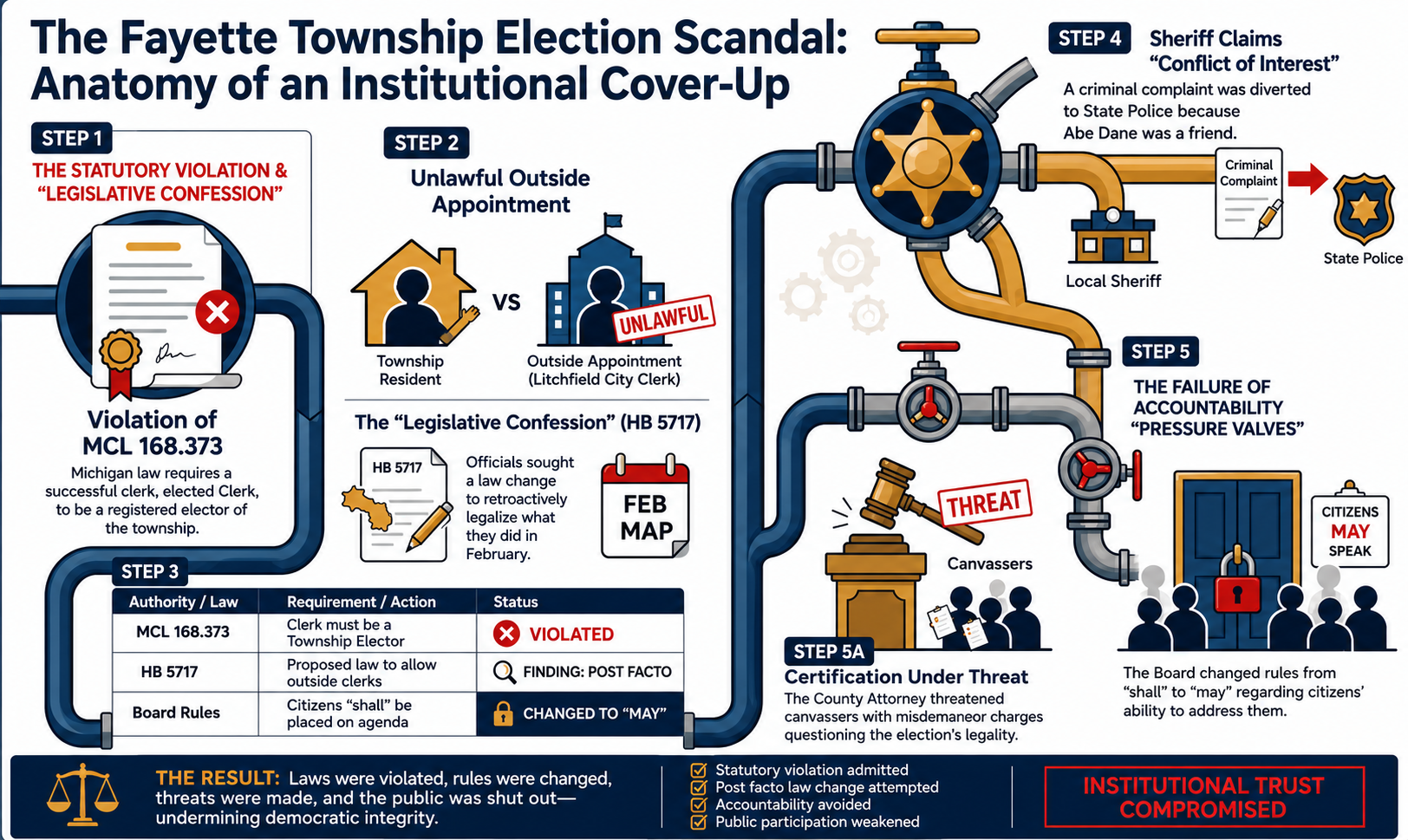
Fayette Township did not have a lawful township clerk in place. The township board tried to patch the problem by appointing the treasurer as “Election Administrator.” Then, when the election came, the Litchfield City Clerk was used to run election duties in Fayette Township even though Michigan law required a substitute to be a qualified registered elector of the township. Current MCL 168.373 says that if neither the township clerk nor a deputy township clerk is available, the township board shall appoint a qualified person who is a registered elector of the township to perform necessary election functions. Link
That law did not say: bring in the Litchfield City Clerk.
That law did not say: let the County Clerk arrange it.
That law did not say: create an “Election Administrator” label and pretend the vacancy is cured.
Then came the tell.
House Bill 5717 was introduced to amend MCL 168.373 so township boards could contract with an accredited individual from outside the township to perform election duties when the township clerk not available. LegiScan lists HB 5717 as introduced March 12, 2026, sponsored by Rep. Jennifer Wortz and Rep. Jay DeBoyer, and describes it as authorizing a township to contract with any accredited individual to perform election-law duties in the absence of a township clerk. Link
WILX reported that the House Committee on Election Integrity heard testimony on HB 5717 on March 17, 2026, and that the bill would let township boards hire a qualified, accredited election official from outside the township if the clerk’s seat was vacant or there was no trained deputy to step in. WILX also quoted Hillsdale County Clerk Abe Dane discussing the pressure on rural clerks. Link
That is the key.
If the conduct was already lawful, HB 5717 would not be necessary.
If county clerks could already arrange outside clerks to run township elections, Lansing would not need to change MCL 168.373.
If township boards could already bypass the clerk’s office and install substitute election administrators from outside the township, then the bill would have been pointless.
It was not pointless.
It was a legislative confession.
Fayette Township did in February what Abe Dane went to Lansing in March to legalize. And this did not happen in a vacuum. Dane’s office had already been accused of unlawfully administering multiple Adams Township elections, destroying election data, and taking election materials that belonged under township custody. The Fayette election was not the first warning sign. It was the fourth warning sign.
Exhibit 1: The Vacancy They Pretended to Fix

On February 9, 2026, the Fayette Township agenda listed Item 8F:
“Appointment of Election Administrator.”
According to confirmed information, the board appointed Nancy DuBois, the township treasurer, as Election Administrator.
That did not make her township clerk.
That did not make her deputy clerk.
That did not cure the statutory vacancy.
It created a label.
And labels do not rewrite election law.
Exhibit 2: The Township Knew It Still Had No Clerk

By May 1, the township’s own Election Commission notice admitted the truth.
The Fayette Township Election Commission listed its board members as:
VACANT, Clerk
Nathaniel Baker, Supervisor
Nancy DuBois, Treasurer
The purpose of that May 1 meeting was the “Emergency Appointment of Election Inspectors, Chairperson, Receiving Board & Closing Board Inspectors for the May 5, 2026 Special Election.”
Four days before the election, Fayette Township still had no clerk.
The February appointment did not fix it.
The township knew it.
The county knew it.
The documents said it in black and white.
Was the logic and accuracy test conducted legally?
Exhibit 3: The Complaint That Made Ignorance Impossible
On May 5, 2026, the day of the Fayette Township special election, Stephanie Scott filed an Election Law Violation Complaint with the Hillsdale County Sheriff’s Office.
The complaint laid out the statutory issue directly. It alleged that Cassidy Taylor, the Litchfield City Clerk, was managing the Fayette Township May 5 special election in the capacity of clerk, that Taylor was not a resident of Fayette Township, and that current MCL 168.373 required a substitute to be a qualified elector of the township.
The complaint also stated that HB 5717 had not been voted into law and that applying its proposed language would be a post facto application of law.
That matters.
The complaint did not merely say, “Something feels wrong.”
It named the law.
It named the defect.
It identified the person performing the duties.
It identified the pending bill that would change the law.
It stated the county clerk knew the current statute did not allow what was happening.
And it was filed with the Sheriff before the county could pretend nobody had raised the issue.
The Sheriff’s Conflict Was Not a Solution
After the complaint was filed, the Sheriff’s Office did not publicly answer the legal issue.
According to the second complaint, Detective Sergeant Rathbun called Stephanie Scott around 5 p.m. on May 5 and said the matter was being referred to the Michigan State Police because of a “conflict of interest.” The same complaint states that Sheriff Hodshire had previously claimed a conflict of interest because Abe Dane was “his friend.”
That is not accountability.
That is the problem announcing itself.
A conflict of interest does not erase a statutory duty. It does not make an election-law complaint disappear. It does not answer whether Fayette Township’s election was lawfully administered.
A real conflict should trigger independent review.
Here, it became another delay valve.
The Sheriff did not investigate the county clerk.
The Sheriff did not produce a public legal analysis.
The Sheriff did not reassure the people that the law had been followed.
He claimed conflict.
And the county moved on.

Then the Commissioners Were Told
After the Fayette election and after the complaint, the issue was brought directly to the Hillsdale County Board of Commissioners.
The Commissioners were told plainly:
“The fact that the Litchfield City Clerk ran a township election, a different township, ran that election is in violation of MCL 168.373.”
They were told this was not new.
They were told Abe Dane had allegedly done the same thing in Adams Township.
They were told Abe Dane knew the law limited him because he had testified in Lansing on the bill to change it.
They were told:
“He knows he is because he presented your sister’s bill to the state legislature about changing it…”
They were told the Sheriff’s answer was conflict of interest.
They were told the County Clerk was a county officer paid by county taxpayers.
They were told the Board had authority through the checkbook, oversight, and public governance.
And they did nothing.
That is when this stopped being merely a clerk problem.
It became a county government problem, for the fourth time.
Then a Canvasser Put It in Writing
On May 7, 2026, Lawrence T. Peter, a member of the Hillsdale County Board of Canvassers, issued a memorandum titled:
“Potential Irregularity in Fayette Township Election — 5 May 2026 Special Election.”
This was not a social media post.
This was not a campaign complaint.
This was a county canvasser placing the issue into the official record.
Peter’s memo was sent to the Hillsdale County Board of Canvassers and requested to be copied to the Prosecuting Attorney, Corporation Counsel, Michigan Secretary of State Bureau of Elections, and Hillsdale County Clerk Abe Dane.
Peter wrote that Fayette Township had operated without a township clerk or deputy clerk for some time. He wrote that, for the May 5 election, County Clerk Abe Dane arranged for the Litchfield City Clerk to serve as acting clerk for Fayette Township. He quoted MCL 168.373 and stated that the individual appointed did not meet the statutory requirement.
Then came the line that made ignorance impossible:
“County Clerk Dane has publicly acknowledged the limitations of current law and supported legislation (HB 5717) to allow broader appointments in such cases.”
Peter was not claiming authority to invalidate the election.
He stated his role as a canvasser was ministerial.
But he asked for three basic things: enter the memorandum and complaint into the record, seek a formal written legal opinion from the Prosecuting Attorney or Corporation Counsel, and refer the matter to the Prosecutor and Secretary of State Bureau of Elections.
That was the lawful pressure valve.
It was right there.
A county canvasser identified the defect, preserved the record, named the statute, copied the proper authorities, and asked for review.
So what did the county do?
It changed the question.
The County Attorney Did Not Answer the Question


County Attorney Thomas Thompson responded with a memorandum dated May 11, 2026.
But he did not answer Peter’s question.
Peter asked whether Fayette Township’s acting-clerk arrangement complied with MCL 168.373.
Thompson answered whether county canvassers have a ministerial duty to certify returns.
Those are not the same question.
Michigan law does give county canvassers a ministerial, clerical, nondiscretionary duty to certify election results based on the statements of returns. MCL 168.822 addresses county canvassers’ duties and the process if they fail to certify within the statutory timeframe.
But that did not answer the underlying defect.
Thompson did not say:
Fayette Township’s appointment complied with MCL 168.373.
He did not say:
The Litchfield City Clerk was a qualified registered elector of Fayette Township.
He did not say:
Abe Dane had statutory authority to arrange for an outside city clerk to act as Fayette Township’s clerk.
He did not say:
HB 5717 was already law.
Instead, he told canvassers they had to certify, and he threatened that failure to perform a statutorily mandated function could be a misdemeanor under MCL 168.931(1)(g).
That was not an answer.
That was pressure.
The county did not resolve the defect.
It threatened the canvassers and covered up the fact the County Clerk violated laws.
Peter Answered the Threat and Exposed the Dodge
At the next canvass meeting, Lawrence T. Peter entered another memorandum into the record.
This second memo is devastating because it removes the county’s preferred excuse.
Peter was not refusing to certify.
He was not trying to audit the election.
He was not trying to look behind the returns.
In his May 12 memorandum, Peter wrote that he accepted Thompson’s analysis of the canvassers’ ministerial duty and had “no intention of withholding certification.” He stated he would certify the election results as required.
Then he said the part county officials did not want in the record:
“My original questions remain unanswered.”
Peter repeated the questions:
Did the appointment process used for Fayette Township’s acting clerk satisfy MCL 168.373?
If not, did that noncompliance render the Fayette Township election returns invalid?
Those were the questions.
They were simple.
They were lawful.
They were necessary.
And they were still unanswered.
Certified Under Threat
Then Peter said it aloud.
He told the Board he would certify because he did not want to be charged with a criminal misdemeanor.
His words:
“Yes, I will certify… because I certainly don’t want to be charged with a criminal misdemeanor for failure to certify.”
That is not confidence.
That is not trust.
That is certification under threat.
Peter continued:
“I find it shocking that it would come to this point where asking a question about legal processes would result in a legal sanction, but there we are.”
Then he repeated:
“My original questions remain unanswered.”
That is the heart of this story.
Not one official answered the plain language of the law.
Not the County Clerk.
Not the Sheriff.
Not the Prosecutor.
Not the County Attorney.
Not the Commissioners.
Not the Board of Canvassers as a body.
Peter certified, but he did not concede.
He complied with the ministerial duty while preserving the record that the county had never answered whether Fayette Township’s election had been lawfully administered.
The Second Complaint: From Unlawful Election to Fraudulent Records
After that meeting, a second complaint was filed.
This complaint did not merely allege that the Fayette Township election had been unlawfully administered.
It alleged the cover-up after the unlawful election.
The second complaint, dated May 15, 2026, states that it was the second complaint filed with the Hillsdale County Sheriff’s Department concerning the May 5 Fayette Township election. It also states that the first complaint had been assigned case number 26-3979, and that the Sheriff’s Department referred the matter to the Michigan State Police due to conflict of interest.
The second complaint argues that Thompson did not address the actual issue Peter raised, which was whether the Fayette Township election was lawful under Michigan statutes. It states that Thompson advised the canvassers to certify and included a misdemeanor warning, while leaving unanswered whether the records presented to the canvassers were legally valid in the first place.
Then the complaint lays out the chain:
If there was no lawful election commission, the election inspectors were not lawfully appointed.
If the election inspectors were not lawfully appointed, the certificates they signed were not lawful.
If the certificates presented to the Board of Canvassers were not lawful, the canvassers did not have lawful records to certify.
That is why the second complaint alleges fraudulent election records were presented to the Hillsdale County Board of Canvassers.
That is the difference between error and cover-up.
Error says:
We did not know.
Cover-up says:
We were told, and we certified anyway.
Where Was WCSR & Hillsdale Daily News?
This is where the local media becomes part of the story.
Local News does not get to claim ignorance forever.
This was not hidden.
There was a township agenda.
There was an Election Commission notice.
There was a formal complaint.
There was a Sheriff’s conflict claim.
There was public comment before the Commissioners.
There was a canvasser memorandum.
There was a County Attorney memorandum.
There was a second canvasser memorandum.
There was a public statement from Lawrence Peter saying he felt threatened with legal sanction for asking a question.
There was a second criminal complaint.
There is now an MSP investigation.
And through all of it, where was the local media?
WCSR covers local government when it wants to. It covered the March 10 Board of Commissioners meeting that was adjourned after public turnout overfilled the room, reporting that Mark Wiley, chairman of the County Board of Commissioners, said the adjournment left county business undone.
They had no problem using their platform to cover for the County Clerk.
So the question is not whether WCSR knows how to cover county government.
The question is why this story, with documents, complaints, sworn controversy, public officials, election law, and now state police involvement, has not received the serious coverage it deserves.
At some point, silence stops being absence.
It becomes participation.
Local media does not have to forge records to assist a cover-up. Although WCSR clearly does…
It can simply refuse to tell the public what the records say.
It can treat citizen evidence as noise.
It can treat public officials as the default source of truth. “Except for when they are threatened by their friends in the local government and sheriffs department.”
It can cover the process while ignoring the abuse inside the process.
It can report the meeting and miss the scandal.
That is how local corruption survives.
Not because nobody knows.
Because the people with microphones and well established community platforms keep deciding the public does not need to know.
The Pattern
This is the Hillsdale County pattern now.
First, officials act outside the law.
Then they call it an emergency.
Then they tell the public it is administrative.
Then they tell clerks not to worry.
Then a citizen files a complaint.
Then the Sheriff claims conflict.
Then the Commissioners shrug.
Then the County Attorney narrows the question.
Then the canvassers are told to certify.
Then the media looks away.
Then the Legislature is asked to change the law so the next violation looks legal.
That is not a mistake.
That is a system.
A system that Threatens everyone who dares ask a question.
And Then They Changed the Rules
This story does not end with Fayette Township.
It ends where every Hillsdale County accountability story now seems to end:
With the Board of Commissioners protecting itself from public accountability.
For years, Hillsdale County’s rules gave citizens a clear path to address the Board in an extensive manner. The 2005 Board rules said that when a person desired to address the Board in an extensive manner, that person “shall be placed on the agenda” for a reasonable period of time by contacting the administrative office at least seven days before the meeting.
That word mattered.
Shall.
Not may.
Not if the Chair feels like it.
Not if the subject is comfortable.
Not if the official being challenged approves.
Shall.
But under the current Board, with Mark Wiley as Chair, that public-access protection was changed. Prior reporting documented that the February 10, 2026 bylaws changed the rule from “shall be placed on the agenda” to “may be placed on the agenda,” at the discretion of the Chairperson.
That was not a small edit.
That was a power transfer.
It moved access from the citizen to the Chair, the self appointed King of Hillsdale County.
And now, when citizens seek to bring election-governance concerns before the Board, the same county structure that ignored the complaints, dodged the questions, and refused accountability has a procedural shield ready.
The Chair controls the agenda.
The public gets five minutes.
The Board avoids deliberation.
The County Clerk remains protected.
The Sheriff claims conflict.
The Prosecutor stays quiet.
The County Attorney threatens certification dissenters.
The local media looks away, and now Targets those dissenters.
And the people are told this is government.
No.
This is not government.
This is managed access.
This is institutional self-protection.
This is what a cover-up looks like before anyone gets handcuffed.
Not smoke-filled rooms.
Not bags of cash.
Not dramatic movie villains.
Just agendas.
Memos.
Silence.
Conflicts of interest.
Unanswered questions.
Threatened canvassers.
Targeted dissenters.
Media avoidance.
And one little word changed from shall to may.
That is how the door closes.
And in Hillsdale County, it has been closing for a long time.
The people of this county should understand what happened in Fayette Township.
They knew before the election.
They were warned during the election.
They threatened the canvasser who asked questions.
They certified anyway.
Then they hid behind procedure.
And when the public tried to bring it to the Board, the Board had already rewritten the rules.
That is the story the local media refused to tell.
So we will.
In liberty,
Stephanie Scott & Lance Lashaway


Source Links & Supporting Documents
Michigan Election Law / Statutes
MCL 168.373 — Township clerk; substitute for election duties
https://legislature.mi.gov/Laws/MCL?objectName=mcl-168-373
MCL 168.822 — Board of county canvassers; canvass and certification duties
https://www.legislature.mi.gov/Laws/MCL?objectName=mcl-168-822
MCL 168.861 — Recounts; recount is not an investigation or audit
https://www.legislature.mi.gov/Laws/MCL?objectName=mcl-168-861
MCL 168.931 — Prohibited conduct; misdemeanor provisions
https://www.legislature.mi.gov/Laws/MCL?objectName=mcl-168-931
MCL 168.931b — Intimidation/interference with election workers
https://www.legislature.mi.gov/Laws/MCL?objectName=mcl-168-931b
MCL 168.2 — Definitions under Michigan Election Law
https://legislature.mi.gov/Laws/MCL?objectName=mcl-168-2
MCL 168.719 — City and township election commissions; duties
https://www.legislature.mi.gov/Laws/MCL?objectName=mcl-168-719
MCL 168.940 — Prosecuting attorney; duty to prosecute election offenses
https://www.legislature.mi.gov/Laws/MCL?objectName=mcl-168-940
MCL 168.941 — Peace officers; duty to institute proceedings
https://www.legislature.mi.gov/Laws/MCL?objectName=MCL-168-941
MCL 168.934 — Misdemeanor penalty under Michigan Election Law
https://www.legislature.mi.gov/Laws/MCL?objectName=MCL-168-934
MCL 168.935 — Felony penalty under Michigan Election Law
https://www.legislature.mi.gov/Laws/MCL?objectName=mcl-168-935
MCL 750.248 — Forgery / false public records
https://www.legislature.mi.gov/Laws/MCL?objectName=MCL-750-248
Michigan Constitution, Article II, Section 7 — Boards of canvassers; certification of election results
https://www.legislature.mi.gov/Laws/MCL?objectName=mcl-Article-II-7
MCL 168.811 — Preservation of election returns, records, and applications
https://www.legislature.mi.gov/Laws/MCL?objectName=MCL-168-811
52 U.S.C. § 20701 — Federal election record retention
https://uscode.house.gov/view.xhtml?edition=prelim&num=0&req=granuleid%3AUSC-prelim-title52-section20701
House Bill 5717
HB 5717 — Michigan Legislature official page
https://www.legislature.mi.gov/Home/GetObject?ObjectName=2026-HB-5717
HB 5717 — Michigan Legislature bill text PDF
https://www.legislature.mi.gov/Home/GetObject?objectName=2026-HCVBH-5717-0O338.pdf
HB 5717 — LegiScan summary
https://legiscan.com/MI/bill/HB5717/2025
WILX coverage of HB 5717
https://www.wilx.com/2026/03/18/michigan-bill-would-allow-townships-hire-outside-election-officials-when-clerk-seat-is-vacant/
Hillsdale County / Board Rules
Hillsdale County Board of Commissioners 2005 Rules and Bylaws
https://hillsdalecounty.gov/images/boc/procedures-bylaws/boc_rules_bylaws2005.pdf
No Kings? — Hillsdale County’s Governance: Public Access Undermined
https://hillsdale.press/2026/04/11/no-kings/
WCSR: Crowd Forces Adjournment of Commissioners Meeting
https://www.radiohillsdale.com/2026/03/10/crowd-forces-adjournment-of-commissioners-meeting/
Related Hillsdale Press / Hillsdale Conservatives Background
The Witch Hunt Collapsed. Now Hillsdale Must Answer.
https://hillsdale.press/2026/05/01/the-witch-hunt-collapsed-now-hillsdale-must-answer/
The Tabulator That Was Never Missing
https://hillsdale.press/2025/12/04/the-tabulator-that-was-never-missing/
Transcripts of a Broken Republic: Michigan on the Brink
https://hillsdale.press/2025/09/18/__trashed-2/
When WCSR Claims the Court Record “Refutes” You, and the Court Video Says Otherwise
https://hillsdale.press/2026/02/08/when-wcsr-claims-the-court-record-refutes-you-and-the-court-video-says-otherwise/
Notice Given, Record Made: Why Hillsdale County Commissioners Are Now Accountable
https://hillsdale.press/2026/01/29/notice-given-record-made-why-hillsdale-county-commissioners-are-now-accountable/
Sworn Admissions and the County Commissioners’ Duty
https://hillsdale.press/2026/01/09/sworn-admissions-and-the-county-commissioners-duty-oaths-on-the-record-silence-in-office/
Video Evidence
County Commissioners informed about Fayette Township / MCL 168.373 issue
https://www.youtube.com/shorts/QgzXlKUm7pM
Abe Dane speaking to the Board of Canvassers
https://www.youtube.com/shorts/iPG6woBnZuI
Lawrence Peter states he will certify under threat of misdemeanor charge
https://www.youtube.com/shorts/iErLdYmn_Zw
Hillsdale County Board of Canvassers meeting referenced in Complaint #2
https://www.youtube.com/watch?v=0DJA_Fw8X5k&t=415s
Leave a Reply