The Redcoats of Hillsdale County
THE HILLSDALE CONSERVATIVES
Truth • Liberty • Local Stewardship
Hillsdale County, Michigan • Oct 25, 2026 • 2¢
There’s something wonderfully ironic about living in a community where nearly everyone claims to admire the Founding Fathers.
We celebrate the American Revolution, quote the Constitution, proudly defend liberty, and remind anyone willing to listen that government derives its authority from the consent of the governed.
Then somebody walks into a government meeting and decides to put those principles into practice.
Suddenly, the revolution isn’t quite so popular. The colonists are belligerent squawkers who dared to criticize the crown.
It’s easy to admire the courage of the colonists when the British are safely tucked away in a history book. It’s considerably less convenient when the people questioning authority are your neighbor, the people being questioned are your friend, and the uncomfortable truth might threaten a position you’ve held for years.
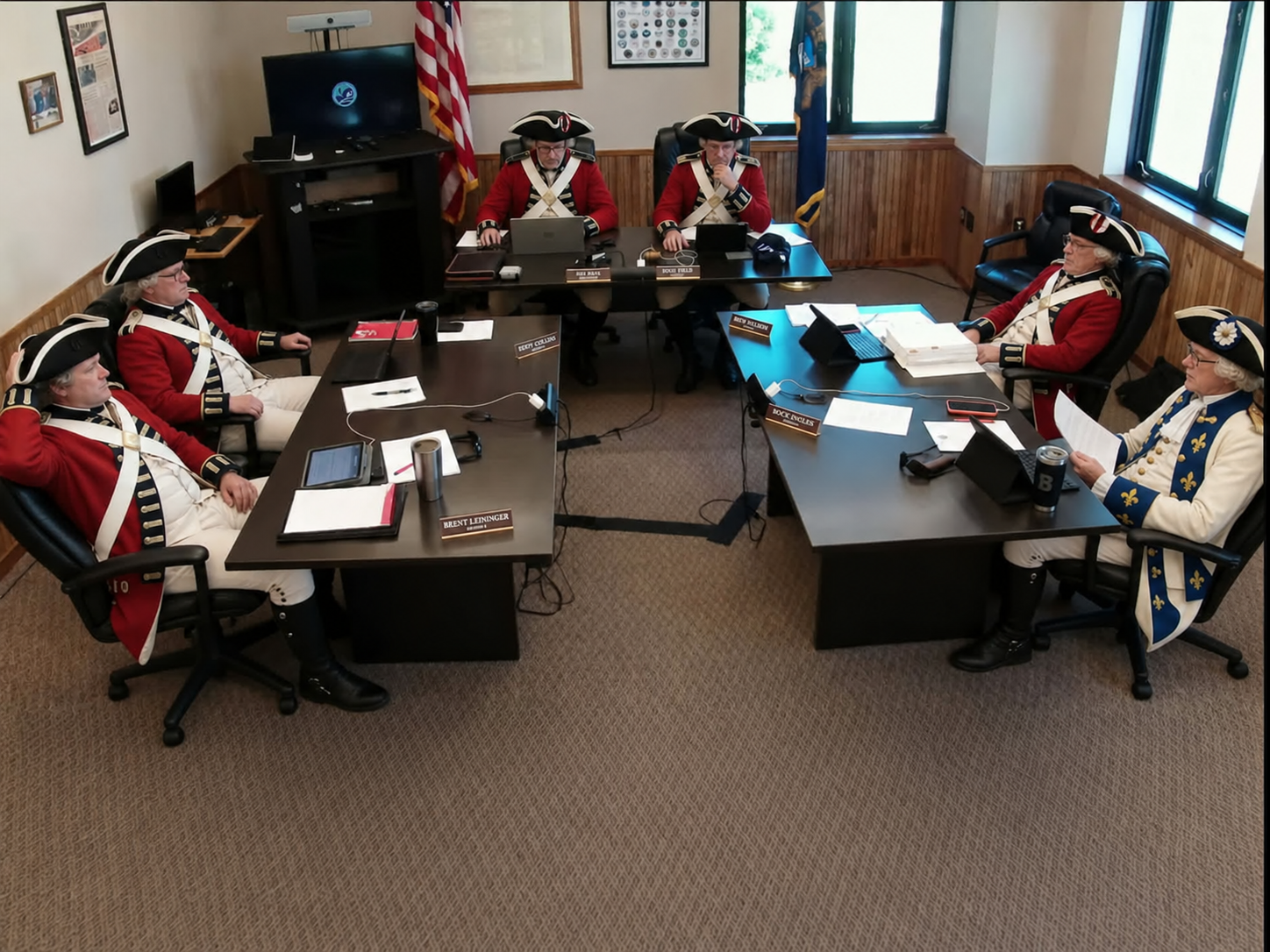
Perhaps that’s what makes the accompanying picture so entertaining.
Nobody in it is actually a British soldier. They’re American citizens, elected by other American citizens, sitting in an American government building.
And yet, somehow, the red coats seem to fit and the colonists only ally still isn’t fully on their side.
The past several years have provided Hillsdale County with a fascinating opportunity to examine something far more important than any individual controversy.
What happens when the people responsible for exercising government authority begin treating those who question it as adversaries rather than the very people they serve?
The Founding Fathers understood that question rather well.
It’s one of the reasons we have a Constitution in the first place.
But perhaps the more uncomfortable question is not what happens to government.
It’s what happens to everyone else when government begins using force against the people questioning it.
After all, tyranny rarely announces itself as tyranny. It generally arrives with an explanation, a regulation, an official opinion, or a perfectly reasonable-sounding justification for why something must be done.
The British Crown had laws, courts, appointed authorities, and plenty of legal explanations for its conduct in the American colonies.
The colonists had something considerably more troublesome.
Questions.
Questions about representation, taxation, property, authority, and whether the Crown possessed powers it claimed for itself.
And when those questions became inconvenient, the Crown did not simply disagree.
It enforced its authority.
Of course, government must possess the ability to enforce legitimate laws. Maintaining public order is a necessary responsibility, and neither the Constitution nor the Founding Fathers established an proclaimed anything to the contrary.
But that distinction is precisely why the exercise of government force is limited by the Constitution.
There is a difference between enforcing the law and using rules as an excuse to enforce obedience.
In Hillsdale County, that distinction is no longer merely theoretical.
Over the past year, citizens have been removed from public meetings following disputes over public-comment requirements. At Hillsdale City Council, a controversy over whether identifying oneself was requested or required ultimately resulted in the council amending its own rules. Similar disputes at the County Commission involved police escorts and questions about the legal grounds for excluding a person from a public meeting.
Those disputes have now reached federal court.
Officials maintain that they may enforce reasonable procedural rules and remove individuals who refuse to comply. The opposing legal argument challenges whether those requirements and removals violated constitutional and statutory protections.
Changing rules once they become inconvenient has become increasing popular in Hillsdale counties governments. Rules have been changed to avoid pesky election laws and the ability to present grievances to local representatives has also been changed from shall to may.
With rules now preventing a citizens ability to participate in our American form of self government.
Consider how quickly a disagreement over a government rule can become an encounter with a police officer.
One moment, a citizen is questioning the authority of an elected official.
The next, the citizen is being ordered to leave.
And suddenly the question is no longer whether the official was right.
It is whether the citizen will obey.
That is the moment when constitutional principles become considerably more important than political slogans.
It’s also the moment when we discover something about the people watching.
Because there is another participant in nearly every dispute between government and citizenry.
The public.
The neighbors, friends, party members, community leaders, and familiar faces who must decide whether their principles apply to everyone or only to people they happen to like.
Some will defend a stranger’s right to question government.
Others may find themselves defending the government’s actions simply because they dislike the person being questioned, approve of the officials involved, or trust someone who assures them that everything was handled properly.
It is a peculiar form of patriotism.
We are willing to condemn the British for enforcing the King’s authority against our ancestors, yet can find ourselves surprisingly comfortable with the exercise of government power against modern-day American Citizens.
We celebrate those who challenged authority 250 years ago, then sometimes describe those who challenge authority today as troublemakers.
We proudly proclaim that government derives its authority from the people, then treat citizens asking for an accounting of that authority as though they are inconveniencing its rightful owners.
Apparently, liberty is a wonderful thing, provided everyone exercises it quietly and nobody important gets offended.
And perhaps that is the greatest irony of all.
The American colonists were not universally popular, universally agreeable, or universally correct. They disagreed among themselves, challenged one another’s motives, and frequently behaved in ways their neighbors found objectionable.
Some remained loyal to the Crown. Others supported independence. Many wanted nothing to do with the conflict. We see that conflict playing out before our very eyes here in Hillsdale County.
The struggle was not a simple contest between people who were always right and officials who were always wrong.
It concerned something much more fundamental.
Who possessed legitimate authority, where that authority ended, and what happened when government exceeded those limits.
Those questions do not disappear simply because the officials in question are elected Republicans, Democrats, conservatives, or friends we’ve known since childhood.
Nor does a citizen surrender constitutional protections by being unpopular, abrasive, politically inconvenient, or even mistaken.
The Constitution was not written exclusively for agreeable people.
Agreeable people rarely need its protection.
And this brings us back to the redcoats.
One of the more revealing moments of the past two years occurred when County Commission Chairman Mark Wiley characterized some residents opposing the LifeWays bond as a small percentage of the county being “belligerent” and having “squawked.”
He subsequently retracted the remarks.
Yet the controversy illustrates how readily public disagreement can become a dispute over the conduct and character of those participating.
The citizens were no longer simply people with objections to a financial decision.
They had become the belligerent few.
One wonders what King George might have called the residents of Boston after the tea ended up in the harbor.
King George: merely a temporary setback instigated by a few hotheads in Boston.
And before anyone mistakes the comparison for an endorsement of disorder, there is an important difference between historical rebellion and lawful civic participation today.
Our system provides elections, courts, petitions, public-record laws, open meetings, and constitutional remedies precisely so that grievances can be addressed without revolution.
These mechanisms are intended to provide peaceful alternatives to force.
They are not inconveniences government should seek to escape.
That is why their protection matters.
When citizens use those mechanisms, government should be prepared to answer their questions, even when the questions are unwelcome.
And when enforcement becomes necessary, the justification should be grounded in law, applied consistently, and proportionate to the actual conduct involved.
Not personalities.
Not political alliances.
Not whether someone happens to be a friend of the mayor, sheriff, commissioner, or party chairman.
Certainly not changing the rules.
The real test of constitutional principles is not whether we defend the rights of people we admire.
It is whether we defend those same principles when they protect someone we cannot stand.
After all, almost anyone can be a patriot when liberty is nothing more than a flag, a parade, a speech, or a pleasant historical memory.
It requires considerably more conviction when defending liberty means questioning someone you voted for, disagreeing with a friend, or acknowledging that a person you dislike may have been treated improperly.
And it requires something more still when the government has the power to compel compliance.
That is when patriotism stops being a comfortable identity and becomes a matter of principle.
Perhaps Hillsdale County’s greatest lesson from the past serval years has very little to do with bonds, elections, lawsuits, or even the personalities occupying public office.
Perhaps the lesson is about us.
About how easily personal loyalty can be confused with public duty.
How readily political disagreement becomes personal hostility.
How quickly the presumption that government must justify its authority can be replaced by the expectation that citizens must justify questioning it.
And how difficult it can be to recognize conduct we would condemn in a history book when it occurs among people we know.
The Founding Fathers were not asking future Americans to agree with one another.
They were attempting to establish a system in which disagreement did not place liberty entirely at the mercy of whoever held power.
That system demands something from public officials.
It also demands something from the citizens who elect them.
As America celebrates the 250th anniversary of its independence, perhaps we ought to spend a little less time congratulating ourselves for what our ancestors believed and a little more time examining what we are willing to defend today.
Because the redcoats are no longer coming.
We settled that question a long time ago.
The question now is whether we recognize the principles our ancestors fought for when defending them becomes inconvenient.
Everyone’s a patriot until the government uses force.
And then we find out who actually believes in liberty.
in liberty,
Samual Adams

Local reporting and documentation
1. Hillsdale County Review — Week in Review: The Belligerent Few — March 25, 2026.
This is the principal source for Commissioner Mark Wiley’s remarks about residents being “belligerent” and having “squawked.” Importantly, it also documents his subsequent retraction.
by Clovis
2. The Hillsdalian — LifeWays Committee Votes to Put Hillsdale Facility Construction on Hold — November 11, 2025.
Independent reporting by Jacob Bruns documenting Wiley’s original remarks in the context of public opposition to the proposed LifeWays bond.
hillsdalian.substack.com
3. The Hillsdalian — Making Sense of Lance Lashaway’s Legal Complaint — September 30, 2026.
Provides a timeline of public-comment disputes, removals from city and county meetings, the June 1 council rule change, and City Attorney Thomas Thompson’s legal arguments defending identification requirements. This is particularly useful because it presents the officials’ legal position alongside the lawsuit’s claims.
hillsdalian.substack.com
4. The Hillsdale Daily News — Hillsdale Resident Sues City, County Over Public Comment Rules — October 2, 2026.
Corey Murray’s reporting on the federal lawsuit, law-enforcement removals, contested identification requirements, and the city’s response. This is a syndicated copy of the original Hillsdale Daily News report.
Blue Water Healthy Living
5. Hillsdale.press — Hillsdale City Council v. The English Language — June 10, 2026.
Provides the argument concerning the distinction between “requested” and “required,” the June 1 council votes, and the citizen’s removal. This is advocacy-oriented commentary and should be distinguished from neutral reporting.
Hillsdale Conservative Network
Primary government and legal sources
6. City of Hillsdale — Council Rules of Procedure
Official city source confirming that updated procedures were approved June 1, 2026. The city’s meeting archive provides agendas, minutes, and packets for the relevant meetings.
Hillsdale Michigan
+1
7. Michigan Attorney General — Open Meetings Act
Explains public access, participation, and governmental accountability. Especially relevant is MCL 15.263(4)–(6), which distinguishes attending a meeting from addressing it under established rules and limits exclusion from meetings. The Attorney General’s handbook also recognizes that public bodies may require speakers to identify themselves under properly adopted rules.
Michigan.gov
+1
8. National Archives — Declaration of Independence
Primary historical source for the principle of consent of the governed, government deriving its authority from the people, and the American colonies’ grievances against the Crown.
National Archives
9. National Archives — Bill of Rights
Primary source for the First Amendment protections concerning speech, peaceful assembly, and petitioning government for redress of grievances.
National Archives
Leave a Reply