Diogenes Visits the Church of County Government
Satire and commentary based upon County Clerk Abe Dane’s July 17, 2026 public statement, his sworn testimony, official election documents, and hearing video.

I came to Hillsdale carrying my lantern, having heard that the county possessed a man of uncommon virtue.
A man of the church.
A mentor of the young.
A Hero of election security.
A man so righteous, we are assured, that even pastors rise to defend his holy decrees.
His name was Abe Dane, High Clerk of the County, Keeper of the Seals, Defender of the Vendor, and Shepherd of the Electronic Flock.
On July 17, the High Clerk issued an epistle to the people.
The election equipment was “highly secure.”
The testing was “rigorous.”
The programming was “local.”
The internet had been completely cast out.
And anyone who questioned these mysteries merely lacked the “hands-on experience” possessed by the professionals who work with the machines “every day.”
I raised my lantern.
At last, I thought.
A prophet.
Then I read his testimony.
The Gospel According to Hart
The High Clerk proclaimed that Hillsdale County’s election equipment is “programmed locally.”
What a comforting phrase.
One imagines local craftsmen gathered beneath the courthouse, forging lines of computer code beside a wood stove while portraits of Washington and Jefferson look approvingly upon their work.
Perhaps the software was written in Reading.
Perhaps the firmware was fashioned in Litchfield.
Perhaps the sacred algorithms were carried down from Mount Hillsdale on tablets of locally sourced silicon prepared by the Sages whom resided there.
But when placed under oath, the High Clerk described a rather different miracle.
Dane testified that the V-drive is a USB device obtained “directly from the vendor at Hart InterCivic.” The county uses Hart’s election-management-system workstation to place election-specific information onto it. He further testified that the Verity key is another USB device obtained from Hart InterCivic and that both devices are required to install an election on the tabulator.
The county did not create the underlying software.
It did not design the system.
It did not write the firmware.
It did not manufacture the V-drive.
It did not create the Verity key.
The county enters election information into a system built and supplied by Hart InterCivic.
That is local configuration inside a vendor-created system.
It is not local programming in the sense an ordinary resident would reasonably understand from Dane’s proclamation.
And yet Saint Abe received the V-drive from Hart, and the Verity key from Hart, and the software from Hart, and proclaimed unto the people:
Behold, it is local.
Thus I encountered The Apostle of Local Programming, who programs locally the program created elsewhere.
August 12, 2025 transcript here. Transcript pages 3 through 5, especially page 4, lines 1 through 24.]
Read Dane’s sworn testimony concerning Hart’s V-drive, Verity key, and election-management system
For additional official context, the State of Michigan identifies the equipment as the Hart Verity voting system and provides its certification materials here:
Official Michigan information on Hart voter-assist terminals and tabulators
The Sacrament of Rigorous Testing
The machines, the High Clerk assures us, are “rigorously tested.”
Not merely tested.
Not tested according to a prescribed procedure.
Not subjected to a limited pre-election functional test.
Rigorously tested.
The faithful are meant to imagine engineers surrounding the tabulator, examining its software, firmware, hardware, communications components, logs, security controls, storage, and behavior under every conceivable election condition.
What actually occurs is logic-and-accuracy testing using predetermined test ballots for which the expected results are already known.
That test has a legitimate purpose. It determines whether the election configuration and tabulator produce the expected results for the ballots included in the test deck.
But a limited functional test is not an exhaustive technical examination.
It does not mean every line of code was independently reviewed.
It does not mean every firmware component was forensically examined.
It does not mean every possible vote combination was tested.
It does not mean every communication capability was independently inspected.
It does not mean the machine was tested under the volume, duration, handling, and unexpected circumstances of an actual election.
Local clerks have also complained that they were not provided enough test ballots to perform the degree of testing they believed necessary.
Yet the sacred test ballots were inserted.
The expected totals appeared.
The congregation rejoiced.
No further inquiry was permitted, for the sacrament had been completed.
The Michigan Bureau of Elections’ own manual calls this pre-election logic-and-accuracy testing. That is the proper name for the procedure. It is not called a comprehensive software audit, a forensic security examination, or an exhaustive technical evaluation.
Official Michigan pre-election logic-and-accuracy testing manual
The State has also acknowledged that jurisdictions depend upon materials supplied for testing and that ballot and tabulator preparation involves strict time and material limitations.
Thus I encountered The High Priest of Limited Testing, who placed a few known answers before the machine and declared the mysteries of the entire system resolved.
The Communion of Daily Expertise
Dane next invoked the wisdom of election professionals who supposedly work with these machines “every day.”
Every day?
I searched Hillsdale County for these tireless acolytes.
Surely, somewhere in the county, township clerks awaken before dawn, enter the tabulator chapel, light the ceremonial candles, and spend the day contemplating firmware.
Perhaps they take the machines to lunch.
Perhaps they discuss modem architecture over coffee.
Perhaps every evening concludes with family prayer around the Verity Scan.
But I found no such order of technological monks.
The tabulators are used during election preparation, testing, Election Day, and periodic maintenance. They are not ordinary daily office equipment operated continuously throughout the year.
Clerks administer elections throughout the year.
They do not operate tabulators every day.
They may know how to install election media, open the polls, process ballots, print results tapes, close the polls, secure election materials, and follow vendor or state instructions.
Those are important administrative responsibilities.
They do not, by themselves, establish expertise in software engineering, computer networking, cybersecurity, firmware design, electronic data preservation, telecommunications, or system architecture.
Operating a machine is not the same as understanding its internal design.
Following a procedure is not the same as independently verifying the technology upon which that procedure depends.
A man may drive a Ford every day without becoming an automotive engineer.
A woman may use Microsoft Word every day without becoming a software developer.
And a clerk may operate a tabulator during elections without becoming an expert qualified to dismiss every technical concern raised by the public.
Thus I encountered The Shepherd of Daily Machines, tending a flock that spends most of the year in storage.
The Apostle Without IT Experience
Perhaps Dane himself supplied the missing technical expertise.
After all, he issued the proclamation.
He assured the public that the equipment is highly secure.
He assured the public that it is rigorously tested.
He assured the public that it is locally programmed.
He dismissed contrary concerns as the product of misunderstanding and insufficient hands-on experience.
Surely, then, the High Clerk possessed a formidable background in information technology.
But in the hearing video, Dane admitted that he had no IT experience.
Before entering the county clerk’s office in January 2021, his election experience consisted principally of serving as an election inspector in two 2020 elections. His described duties involved assisting voters and balancing the number of voters against the number of ballots.
Those are legitimate election responsibilities.
They are not qualifications in software, cybersecurity, computer networking, electronic data storage, modem functionality, or voting-system design.
Watch Dane’s testimony concerning his lack of IT experience
Under oath, Abe Dane acknowledges that he had no information-technology experience.
The theology of County Government apparently offers a simpler path to technical mastery.
No degree is necessary.
No professional certification is necessary.
No experience in information technology is necessary.
Expertise descends upon the officeholder through election.
The title is bestowed.
The seal is affixed.
The knowledge arrives by administrative grace.
Thus I encountered The Anointed Expert, whose technical authority came not through study, but through stationery.
Saint Abe and the Vanishing Memory
The High Clerk’s education in electronic data preservation contained another minor gap.
During the hearing, Dane acknowledged that he had not understood that replacing the tabulator’s battery could erase stored data.
This was not an obscure question from the outer reaches of computer science.
It concerned routine maintenance and the effect that maintenance could have upon information stored in an election machine.
The official now asking the public to trust his technical judgment did not understand that changing the battery could erase the data.
A humble administrator confronted with such an admission might say:
I administer elections, but I am not an IT expert. Technical questions should be answered through records, documentation, and qualified independent analysis.
But humility is not among the required sacraments of the Church of County Government.
Instead, the High Clerk issued a public proclamation explaining that the real problem is the public’s lack of understanding.
Watch Dane’s testimony concerning the battery replacement and erased data
Dane acknowledges that he did not understand that replacing the battery could erase stored data.
Observe the miracle.
The data disappeared.
The expertise remained.
Thus I encountered The Keeper of Memory, who did not know that ordinary maintenance could erase it.
The Doctrine of Complete Disconnection
Then came the grandest doctrine of all.
The tabulators are “completely disconnected from the internet.”
Completely.
A sacred word.
Not disconnected while ballots are being counted.
Not presently configured against transmission.
Not formerly capable of electronic transmission.
Completely disconnected.
Official records previously submitted in the Adams Township litigation state that the Hart tabulator had a modem physically attached, that the modem was disabled while polls were open, and that electronic transmission could occur after the election was completed and a tabulator tape had been printed.
That document did not say the equipment was incapable of internet or electronic communication.
It said the modem was physically attached and restricted by configuration during voting.
The State’s Hart Verity certification materials also identify Verity Transmit and a 4G MultiTech modem as system components.
Official Hart Verity certification evaluation identifying Verity Transmit and modem hardware
Perhaps every modem in Hillsdale County has since been physically removed.
Perhaps every communications component has been disabled.
Perhaps current inventories, maintenance reports, configuration records, and logs prove that no present capability remains.
Then release them.
Release the equipment inventory.
Release the modem-removal records.
Release the current system configurations.
Release the maintenance documentation.
Release the relevant communications logs.
A declaration on county letterhead is not a network diagram.
The word “completely” is not a forensic examination.
Confidence is not documentation.
Yet in the Church of County Government, the doctrine proves itself.
The machine is completely disconnected because the High Clerk said it was completely disconnected.
To ask for supporting records is to reveal insufficient faith.
Thus I encountered The Exorcist of the Internet, who cast out connectivity by proclamation.
The Heresy of Questions
Dane explained that claims contrary to his assurances “often stem from a misunderstanding of election administration rather than hands-on experience with our processes.”
This is the oldest doctrine of every bureaucratic church:
The official is not mistaken.
The citizen merely fails to understand.
The official does not need to answer the evidence.
The citizen must first prove worthiness to ask.
Questioning the equipment is not inquiry.
It is heresy.
Requesting documentation is not oversight.
It is rumor.
Comparing a public statement with sworn testimony is not responsible citizenship.
It is a failure to respect the mysteries of election administration.
But the questions raised here are not merely administrative.
Who created the software?
Who controls the system?
What exactly is tested?
What is not tested?
What communications hardware is present?
What records are created?
What records are preserved?
What records are erased during maintenance?
What logs exist?
Who has examined them?
Those are technical and documentary questions.
And the High Clerk who dismisses them admitted that he possessed no IT experience and did not understand the data consequences of battery replacement.
His solution is not proof.
It is hierarchy.
The public must trust the clerk.
The clerk trusts the state.
The state trusts the vendor.
The vendor built the system.
And no one should disturb the service by asking who independently verified what.
Thus I encountered The Inquisitor of Public Doubt, prosecuting questions that had outgrown his answers.
The Canon of Official Sources
Saint Abe concluded by encouraging citizens to seek “verified, official sources.”
Splendid advice.
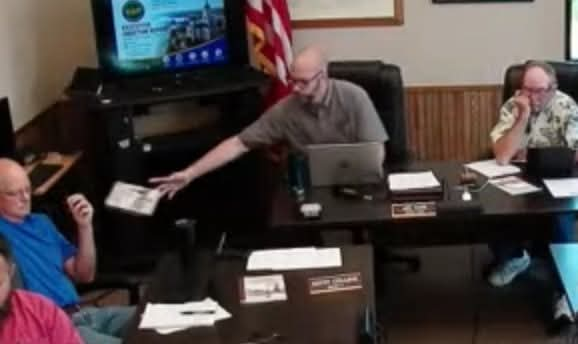
During a Hillsdale County Board of Commissioners meeting, a resident handed Dane a copy of the United States Constitution.
The Constitution is official.
It has been verified for quite some time.
It is superior in authority to a county press release.
The High Clerk’s response was captured on camera.
He threw it aside, perhaps to be destroyed later to keep the citizenry safe from it’s vile contents.

During a Hillsdale County Board of Commissioners meeting, a county resident handed Clerk Abe Dane a copy of the United States Constitution. Dane immediately tossed it aside.
Perhaps the Constitution lacked a county seal.
Perhaps it had not been tested by Hart.
Perhaps its programming was insufficiently local.
Perhaps the Founders had failed to submit it to the Church of County Government for certification.
Or perhaps “official sources” means only those official sources that affirm the official currently speaking.
The symbolism could not have been improved by a professional satirist.
A citizen handed the High Clerk the highest governing authority in the Republic.
The High Clerk cast it aside.
Thus I encountered The Guardian of Official Scripture, carefully separating the canonical government press release from the troublesome apocrypha of the Constitution.
The Book of Sworn Testimony
The High Clerk preached “facts, not rumors.”
On that point, I agree.
Let us open the record.
Dane testified that the V-drive contains cast-vote records. He described those records as a record of each ballot and the votes marked upon it.
He acknowledged deleting electronic poll-book data many times.
He admitted taking Adams Township’s November 2020 ballots.
He agreed that the township clerk had custody of those ballots.
When asked to identify a Michigan statute authorizing him to take them, he could not identify one.
These were not rumors.
They were sworn answers.
The August 11 transcript identifies Dane’s testimony as beginning at page 205. His continued testimony and cross-examination appear in the August 12 transcript, where the table of contents identifies his cross-examination as beginning at page 30.
August 11, 2025 preliminary-examination transcript, Abraham Dane testimony beginning at page 205
August 12, 2025 preliminary-examination transcript, Abraham Dane cross-examination beginning at page 30
The State and county had previously told Adams Township that preventative maintenance did not delete required records and that its modem was physically attached but disabled during voting, with transmission permitted only afterward.
These are precisely the verified sources Dane advised the public to consult.
So consult them.
Read his statement.
Read his testimony.
Watch the videos.
Examine the documents.
Then decide whether Dane’s July 17 proclamation supplies facts or merely arranges carefully selected facts to manufacture reassurance.
Thus I encountered The Apostle of Facts, pursued relentlessly by his own transcript.
Dane the Unquestionable, Destroyer of Records: when questioned under oath.
Deleting EPB flash-drive data
August 12, 2025 transcript, pages 62–65:
Q. But you would agree that there are election records on the EPB flash drive?
A. Yes.Q. And Stephanie Scott raised concerns about deleting that data, correct? Back in February.
A. She was raising concerns about that and also breaking the seals on the ballot storage containers.Q. On what basis do you believe that the order to delete the data on the EPB flash card complied with state or federal records retention laws?
A. Could you repeat the question?Q. Yeah. On what basis, so you have an obligation to preserve data under the law, correct?
A. Yes.Q. Election records, excuse me. And that’s specifically, we just talked about each, every officer has that?
A. Yes.Q. On what basis do you believe that Mr. Brater’s order to delete the data on the EPB flash card complied with state and federal election records retention requirements?
A. As I’ve stated before, I believe that the records which were produced on election night after the polls closed under the supervision of election inspectors representing both parties were the records that needed to be retained. And the data on the EPB was not needed after security was released on the election.Q. And what are you basing that on? Has somebody told you that or do you have knowledge of the data that’s on the EPB flash card?
A. I can’t imagine what would be needed from those, other than a list of voters and what ballots people receive.Q. All right, so, but you’re not an expert in this areas?
A. Correct.Q. So did you ever yourself delete any data from EPB flash cards since 2020?
A. Many times.Q. Have you been given immunity to testify here today from any state or federal official?
A. No.
The cross-examination then established that after the electronic data was deleted, it could no longer be independently compared with the printed reports:
Q. But you would not be able to compare the data on the EPB flash drive because it’s been deleted to the printed reports, would you?
A. I wouldn’t feel the need to do that at that point.Q. Okay. But you wouldn’t be able to do it?
A. Right.Q. And so somebody else coming in to independently audit wouldn’t be able to do, to audit the election, wouldn’t be able to do it either.
A. Not that particular thing, no.
An especially useful lead-in appears immediately before that testimony:
Q. So you didn’t disagree with Clerk Scott’s concerns about deleting election records, correct, and destroying seals?
A. I didn’t disagree that there was a lot of turmoil after the 2020 election.Q. But you also said she has a point.
A. I did.
Taking the November 2020 ballots
August 12, 2025 transcript, pages 143–144:
Q. Can you point to a single law that would allow you to take the township’s ballots from the preceding year’s election, November 2020?
A. No.
Q. Did you take the Adams Township November 2020 ballots?
A. Yes, I did.
Q. And by what authority, it has nothing to do with the November ’21 election, does it?
A. No.
Q. Okay, why did you take the November 2020 ballots?
A. Because during the closing of the election precinct on the evening of November, was that 2nd? There were some poll watchers, including Ms. Scott, who seemed to be fixated on the basement to the township. And so I had maintained supervision of that. I’d never left the whole entire day. So it was open to me. I did not possess a key. But because of the constant comments by the poll watchers that evening, and knowing that Ms. Scott had access to the basement, but also knowing that Jonathan Brater had removed her access from elections, I decided it was in the best interest to possess those records at the county so that they could not be manipulated and then I could be blamed for that.
Q. Well, first of all, the township clerk under Michigan law has custody of the township’s ballots, correct?
A. Correct.
Q. There’s no Michigan law that gives you the authority to take Adams Township ballots, is there?
A. Not specifically.
Q. There’s not even generally any law that would give you custody over the township’s ballots, is there?
A. I am an election administrator. So as long as they are under seal, which at that time I believe the security was released on those ballots, but they maintained their original seal while they were in my possession until there was a FOIA request to have the ballots examined later on.
Dane’s sworn testimony leaves little room for administrative incense. He agreed that the EPB flash drives contained election records, admitted he was not an expert concerning the data, and then acknowledged that he had personally deleted EPB flash-drive data “many times.” When asked whether an independent auditor could later compare the deleted electronic data against the printed reports, Dane conceded: “Not that particular thing, no.”
His ballot-custody testimony was even plainer. Asked whether he took Adams Township’s November 2020 ballots, Dane answered, “Yes, I did.” He admitted the township clerk had custody of them. Asked to identify a single law authorizing him to take the township’s ballots from the previous election, he answered: “No.”
Man is the most intelligent of the animals and the most silly.
I came to Hillsdale searching for an honest man, a hero, a prophet..
Instead, I found a church of government in which a title substitutes for expertise.
A vendor program becomes “local” when operated inside the county building.
A limited functional procedure becomes “rigorous testing.”
Periodic election use becomes work performed “every day.”
A man with no IT experience becomes the final authority on electronic security.
A man who did not understand that changing a battery could erase data lectures the public about its lack of understanding.
A machine previously documented as having a physically attached modem becomes “completely disconnected” through the sacramental power of a press release.
A citizen hands the High Clerk the Constitution.
He throws it aside.
And then he directs the people to official sources.
His defenders speak of virtue.
His office speaks of authority.
His statement speaks with certainty.
But his own testimony speaks louder than all three.
No IT experience.
No locally created program.
No daily use of the machines by clerks.
No understanding that routine battery replacement could erase stored data.
No documentation accompanying the categorical proclamation.
And no humility before the public whose trust he demands.
The vendor built the altar.
The government supplied the priest.
The public was instructed to kneel.
I will not.
His admirers may call him a man of the church.
The county may call him Clerk.
The vendor may call him a customer.
I, Diogenes, have heard the decree, examined the testimony, and raised my lantern over what remains.
The verdict is simple:
Abe Dane, Clerk of Assertions, Keeper of Excuses, and Custodian of Vanishing Records
He has offered certainty where proof was required.
He has demanded faith where records should have been produced.
He has dismissed the questions of citizens while his own sworn testimony supplies the reasons those questions must be asked.
The faithful may bow before the letterhead.
The citizens should read the transcript.
And if Abe Dane cannot answer these contradictions with records, candor, and humility, then one final honorable service remains available to him:
Resign.
in libery,
Diogenes of Sinope


Leave a Reply