Document Everything: A Letter to Hillsdale Conservatives
By Lance Lashaway
Dear Hillsdale Conservatives,
I am writing this not only as a member, but as someone who believes we are standing at a point where ordinary citizens must learn how to document government misconduct calmly, clearly, and thoroughly.
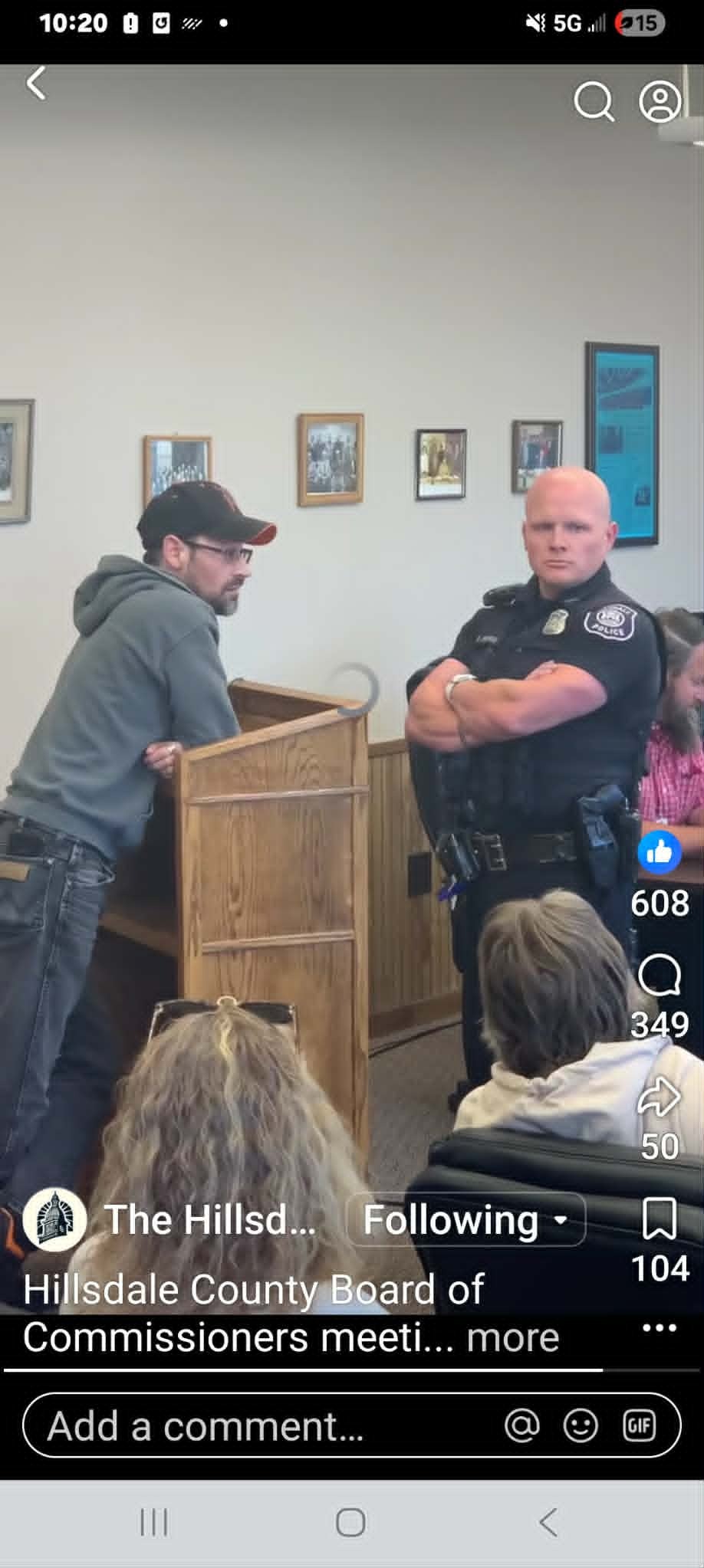
On June 23, 2026, I was removed from a Hillsdale County Board of Commissioners meeting after refusing to surrender my anonymity during public comment. After the meeting, I sent a litigation hold, preservation demand, written statement, complaint, and request for incident reports to the Hillsdale County Board of Commissioners, Chair Mark Wiley, the Hillsdale County Sheriff, the Hillsdale County Prosecutor’s Office, the Hillsdale City Police Chief, Michigan State Police, and the Michigan Attorney General’s Office.
That document is attached at the end of this article. It’s sad that I am more transparent than our local governments.
Contrary to popular belief, and not surprising to anyone who actually knows me, I do not enjoy being the center of attention. I have spent most of my life preferring to be left alone: to farm, run my businesses, raise my family, mind my own business, and avoid unnecessary conflict.
Clearly, that plan has not worked out.
I have lived here my whole life. Generations of my family, on all sides, have lived here for more than a century. I am used to being known. I always have been. I never thought that was odd. There are countless people in this county who are known by practically everyone. I am not special. I am simply from here.
But there is a difference between being known in your community and being forced into becoming a public example because you dared to ask questions.
In Hillsdale County, not seeking attention is somehow treated as though a person should not have a voice. Wanting to be left alone is treated as weakness. Refusing to be dragged into the local rumor mill is treated as suspicious. And simply asking local government to follow its own rules is treated as if the citizen asking the question has become the problem.
There are problems here. If those problems did not exist, I would not be writing this. I have no need to be known. I just am.
Local government has created problems that silence will not fix. I no longer have the luxury of pretending those problems will correct themselves and I am certainly not the only one.
Unfortunately, in Hillsdale County, asking questions of our local representatives and addressing our local governments has become enough to make an ordinary citizen something other than ordinary.
And that is exactly why anonymity matters.
If this is what happens to someone like me, someone already known in the community and willing to create a public record, what happens to the ordinary resident who is not prepared for that fight? What happens to the parent, employee, small-business owner, contractor, student, teacher, farmer, widow, or taxpayer who simply wants to ask a question without becoming the next target of local rumor, retaliation, or official hostility?
Anonymity is not about hiding from accountability. It is about protecting ordinary citizens from being forced into becoming public examples just to hold government accountable. That isn’t representative government.
Our Constitution, laws, and local rules are supposed to be understandable to the ordinary citizen. They are not supposed to be secret codes understood only by attorneys, chairmen, clerks, officers, and insiders. Government derives its authority from the people, and the people must be able to understand the rules being used against them.
There is a reason so much law, procedure, and courtroom analysis comes back to some version of the same basic question:
What would an ordinary, reasonable person have understood, believed, or done under the circumstances?
That question matters here.
Because in Hillsdale County, anonymity is not an abstract issue. It is a practical protection for ordinary people who want to hold government accountable without being dragged through the local rumor mill, targeted online, harassed by political allies of government officials, or socially punished for speaking up.
Anyone who has lived here long enough understands this. People who move here figure it out and are blown away by it, many people move because of it.
There is a class of people in and around Hillsdale County politics who respond to accountability not with facts, law, or reason, but with hostility, rumor, personal attacks, and intimidation. Many of them are, directly or indirectly, connected to local government, political families, public officials, campaigns, committees, or those who benefit from the current so called order. Whether that is coincidence or not, the effect is the same: ordinary residents see what happens to people who speak up.
They see the posts.
They hear the rumors.
They watch the personal attacks.
They see citizens turned into the problem.
They read the “local” paper and listen to local radio.
They see government misconduct excused while the person documenting it is mocked, smeared, or threatened.
This has been part of Hillsdale County’s culture for a long time. “Only in Hillsdale” and “It’s the people” are the polite ways people say it. They are local shorthand for a deeper problem everyone knows exists but too many have been trained not to say out loud.
If you attempt to hold local government accountable here, there is a real chance you will be targeted. Maybe not always by government directly. Sometimes it comes through family members, political allies, online mobs, local insiders, or people who simply want to protect the system as it exists, many people are employed by it. But the message is understood: speak up, and you may become the next target, lose your job, etc etc.
So let us ask the reasonable-person question.
What ordinary, reasonable person would voluntarily subject himself or herself to harassment, stalking, retaliation, rumors, online attacks, and personal destruction simply for asking local government to follow the rules and laws it is already required to obey?
What ordinary, reasonable person would look at the culture of retaliation in this county and believe that forced identification is harmless?
What ordinary, reasonable person would believe that requiring a name before public comment would not have a chilling effect. Everyone knows what happens to citizens who challenge the wrong officials?
The question is not whether a courageous person can survive the attacks. The question is whether an ordinary, reasonable citizen should be forced to risk those attacks as the price of participation in representative government.
The answer should be no.
I write this because the June 23 incident is yet another small example of a much larger problem facing residents across Hillsdale County, our townships, and our cities: government officials applying rules one way when it benefits them, another way when it protects the citizen, and then changing, stretching, or weaponizing those rules when the people object.
This is how representative government dies.
Not all at once. Not usually through one dramatic act. It dies through small abuses repeated so often that people begin to think they are normal. What is happening inside our local governments and law enforcement agencies is not normal, and many people in this county know it, whether they are willing to say it out loud or not.
A citizen is told he cannot speak unless he gives up his anonymity. A rule meant to manage public comment is used as a condition of participation. A peaceful refusal is treated as disruption. A public meeting is recessed. Police are brought in. An officer attempts to move the issue out of public view. The citizen is accused of being the problem. Officials later describe the situation as if the citizen caused the disorder, rather than admitting that the disorder came from the unlawful application of authority.
That is why documentation matters.
Holding government accountable does something very simple and very revealing: it forces representatives to choose.
They can follow the rules and laws they were elected and sworn to uphold, or they can abuse the authority entrusted to them by the people. The best representatives choose the law, even when it is inconvenient. They follow the rules, even when the rules protect a citizen criticizing them. They understand that public office is not ownership of government; it is temporary stewardship of authority that belongs to the people.
The worst representatives do something different. First, they misinterpret the rules in their own favor. If that does not work, they threaten. If that does not work, they change the rules.
They have the authority to change rules because that authority was given to them by we the people. But when that authority is used to strengthen government power and diminish the rights of citizens, it becomes something very different from representation.
That pattern has been on full display in Hillsdale County for years.
The tactic depends on a few misconceptions. Officials rely on the idea that their actions will go unnoticed. They rely on the idea that most people are too busy, too intimidated, or too discouraged to follow the record. They rely on the idea that if they can turn the citizen into “the problem,” then their own abuse of authority disappears.
But it does not disappear.
The phrases “Only in Hillsdale” and “It’s the people” are not new. They are embedded in this county’s history and culture. Hillsdale is a small, tight-knit community. Rumors travel fast. Families overlap. Everyone seems connected to someone. Many families, especially those tied into local government, have been here for generations. Our neighboring counties are much the same.
Hillsdale is rural, independent, and stubborn in the way rural people often are. We do not much like being bothered. We do not much like being told what to do. And we certainly do not like being governed by people who forget that government is supposed to serve the people, not manage them.
There is also something unique about this county. Hillsdale is home to a world-renowned college known for constitutional and conservative learning. This is not an advertisement for Hillsdale College. If Hillsdale College practiced what it preached, Hillsdale County’s local governments would be models of self representation. That however is far from the truth and is simply part of the local reality. For well over a century, the college has shaped the culture, language, and political assumptions of this community. The county is filled with alumni, professors, students, staff, and residents who have spent years around constitutional arguments, conservative principles, moral discussions, through public lectures, free courses, seminars, and civic discussions.
In other words, this is not a county where officials should assume the people are incapable of understanding rules, law, procedure, and constitutional limits, they are supposed to be written for far less studied Americans.
For years, Hillsdale has jokingly and rightly been called “Hazard County” because of its exceedingly rural nature. But beneath the joke is a serious point: this county is full of farmers, tradesmen, business owners, professors, students, retirees, parents, taxpayers, and ordinary citizens who may not attend every meeting, but who understand fairness when they see it and recognize abuse when it becomes impossible to ignore.
That is what is happening now.
The conduct of our local governments is not going unnoticed. People across the county, from farmers to professors, are beginning to take serious interest in how local government is behaving. Meetings that just a few years ago had only a handful of attendees are now regularly filling rooms. Some meetings are becoming so full that larger venues are legally required to accommodate the public. Residents are watching. Residents are recording. Residents are reading the rules. Residents are asking questions.
And the silence from many representatives, in the face of constant public backlash, is deafening.
After I was removed from the County Commissioners meeting, a city police officer told me that if I wanted change, I should do it at the voting booth. That is a line citizens have heard forever. And yes, elections matter. Voting matters. But the voting booth is not an excuse for unlawful conduct between elections. It does not excuse the abuse of authority. It does not excuse officials changing laws and rules to benefit their own authority. It does not excuse lawlessness by local government. It does not excuse officers of the law who just follow orders.
A citizen’s rights do not disappear until the next election.
Our representatives are bound by law today. Our police officers are bound by law today. Our sheriff is bound by law today. Our prosecutors are bound by law today. The Open Meetings Act is not suspended until the next campaign season. The First Amendment is not postponed until November. The Michigan Constitution is not optional because a chairman, commissioner, officer, or attorney finds it inconvenient.
That is the point many officials seem determined not to understand.
The Sheriff has authority and a duty to uphold the law. That duty does not only apply to ordinary residents. It also applies when local government officials are accused of violating the law. It applies when city police are accused of enforcing unlawful orders. It applies when deputies, officers, commissioners, clerks, boards, and public bodies act outside their lawful authority.
When the Sheriff remains silent on these matters, that silence becomes part of the public concern. When city police enforce the will of local officials instead of the law that binds those officials, that becomes a public concern. When reports are delayed, avoided, ignored, or never taken, that becomes a public concern. When no one in authority appears willing to hold government accountable to the same standard applied to ordinary citizens, that becomes more than a county secret.
It becomes a county problem.
And it is quickly becoming a very big one.
The issue at the County meeting was not whether public bodies may have rules. They may. The issue is whether a public body may isolate one phrase from its rules and apply it in a way that defeats the Constitution, the Michigan Constitution, the Michigan Open Meetings Act, and the rest of its own rule.
The Board’s Rule 5.13 must be read as a whole, subordinate to the United States Constitution, including the First Amendment, the Michigan Constitution, and PA 267 of 1976, Michigan’s Open Meetings Act. The Board may not isolate one sentence of Rule 5.13 and apply it in a manner that defeats the constitutional and statutory protections governing open public meetings.
That is the heart of the matter.
Rule 5.13 begins by stating that members of the public shall be encouraged to attend open meetings and address the Commission. It also provides that no person shall be excluded from a public meeting except for a breach of peace committed at that meeting. The portion concerning recognition by the chair and giving a name cannot be separated from those protections and transformed into a weapon against attendance, public participation, or anonymous petitioning.
At no time did I commit, threaten, or attempt any breach of the peace.
According to the preservation demand I sent, my refusal to surrender my anonymity was treated as grounds to deny public comment and then as grounds for removal from an open public meeting. The demand states that this application was unlawful because it converted a public-comment procedure into compelled identification, then converted refusal to identify into exclusion from attendance, despite no breach of the peace.
That distinction matters for every citizen in Hillsdale County.
If government can turn a public-comment rule into a compelled-identification rule, then turn refusal into grounds for removal, then the right to attend and address government becomes conditional on obedience to whatever interpretation officials choose in the moment.
That is not representative government.
It is especially troubling because this incident did not happen in a vacuum. Across Hillsdale County, we have seen a growing pattern of public officials ignoring plain language, changing rules after the fact, narrowing public access, and treating citizens who object as the problem.
When a rule says “shall,” they treat it as “may.”
When a rule says the public may attend, they treat attendance as permission.
When citizens question them, they accuse the citizens of causing disorder.
When the people expose the abuse, officials modify the rules to protect themselves and strengthen their authority.
Consider the percussion of Stephanie Scott, while Abe Dane remains free from accountability.
That pattern is bigger than one meeting, one board, one police officer, one commissioner, or one citizen.
This is why I am asking citizens to learn the process.
When something happens, do not rely on outrage alone. Outrage fades. Records remain.
Document the rule. Document the law. Document the names. Document the time. Document the exact words spoken. Record the meeting if lawful. Save the agenda. Save the packet. Save the minutes. Request the video. Request the body camera. Request the dispatch logs. Request the emails. Request the texts. Request the drafts. Request the legal opinions. Request the communications before and after the meeting.
Then send a preservation demand before the records disappear.
A proper litigation hold does several things. It places officials on notice that litigation is reasonably foreseeable. It tells agencies not to delete, overwrite, alter, or lose relevant records. It identifies the evidence that must be preserved. It creates a written record that the citizen attempted to report the matter. It prevents officials from later pretending they did not know the issue existed.
In this case, the preservation demand identifies the June 23, 2026 Board of Commissioners meeting, my attempted public comment, the demand that I state my name, my refusal to state my name, the decision to remove me, the involvement of Hillsdale City Police, my same-day attempt to make a report with the Sheriff’s Office, my same-day written statement and request for appointment with the Prosecutor’s Office, and the officer’s statement that he had spoken with the Prosecutor’s Office and was told that if I “continue,” I would be charged with a crime.
Those facts matter.
After I was removed, I attempted to report the matter in person to the Hillsdale County Sheriff’s Office. I was told that Sheriff Scott Hodshire personally requested my phone number so that he could call me and take or arrange the report after the meeting he was in. As of the sending of the preservation demand, I had received no call and no report had been taken from me.
I also went to the Hillsdale County Prosecutor’s Office after being told by a Hillsdale City Police officer that he had spoken with the Prosecutor’s Office and that if I “continue,” I would be charged with a crime. I requested a meeting, was told the Prosecutor was not available, and submitted a written statement concerning what had been said. I left my phone number and email address.
These are not side issues. They are part of the record.
If an officer invokes the Prosecutor’s Office after a citizen is removed from a public meeting, that communication should be preserved. If the Sheriff’s Office delays or fails to take a same-day report concerning alleged violations of law by the Board of Commissioners and city police, that fact should be preserved. If public officials claim a citizen breached the peace, while video shows the citizen remained peaceful, respectful, and calm, that video should be preserved.
The point is not to yell louder than government.
The point is to create a record stronger than their excuses.
This is the lesson for every resident: government misconduct often depends on confusion, intimidation, missing records, and silence. A citizen defeats that by being calm, specific, lawful, and persistent.
You do not need to be a lawyer to preserve the truth.
You need to know the rule they claim to be enforcing. You need to know the higher law that governs the rule. You need to know the difference between attending a meeting and addressing a public body. You need to know that exclusion from an open meeting is not supposed to be based on irritation, embarrassment, disagreement, or refusal to comply with an unlawful demand. You need to know that if officials claim “breach of peace,” the evidence must show an actual breach of peace.
And you need to know that every small abuse matters.
The person denied public comment at a township meeting matters.
The parent ignored by a school board matters.
The taxpayer stonewalled by a clerk matters.
The resident removed from a city council meeting matters.
The citizen told to identify himself before addressing his government matters.
The voter told the rules changed after the government got caught matters.
These are not isolated annoyances. They are the working parts of local tyranny.
Tyranny does not always arrive with soldiers in the street. Sometimes it arrives with a chairman’s interpretation, a commissioner’s motion, a police officer’s threat, a missing report, an unanswered appointment request, a refusal to investigate, and a later claim that the citizen was the problem.
That is why we document.
That is why we preserve records.
That is why we publish.
That is why we refuse to let officials rewrite the facts after the meeting ends.
This article concerns allegations and issues preserved in a litigation hold and written statement sent to public officials. No court has yet ruled on these claims. The purpose of writing this now is to place the matter before the public, explain the process, and show citizens how to respond when local government violates the basic rules it is supposed to follow.
My advice to every Hillsdale County resident is simple:
When they violate your rights, stay calm.
When they misapply the rules, ask them to identify the rule.
When they accuse you of disorder, preserve the video.
When they remove you, document who ordered it.
When police get involved, request the body camera.
When officials refuse to take a report, document the refusal.
When they claim the law is on their side, read the law yourself.
When they change the rules after the fact, preserve the old rule, the new rule, and the vote.
And when those in government cannot be trusted to follow the basic rules and laws, when they change those rules to strengthen their authority and diminish ours in the process, we no longer have representative government.
We have tyranny.
The answer is not fear.
The answer is recordkeeping, courage, public accountability, and citizens who refuse to be trained into silence.
Sincerely,
Lance Lashaway
in liberty,
Richard Phallus Johnson III

Leave a Reply