THE HILLSDALE CONSERVATIVES
Truth • Liberty • Local Stewardship
• Hillsdale County, Michigan • March 18, 2026 • 2¢
The Facts
We want to make one thing unmistakably clear from the beginning: the student journalists at the Collegian had been doing exactly what a free press is supposed to do. They were asking hard questions, covering real controversy, and reporting truths that people in power clearly did not appreciate seeing in print. They were shining light where others preferred shadows.
And for that, they have been reined in.
By the city’s own public admissions, concerns were raised about coverage that cast city government in a negative light. Those concerns led to discussions with the college newspaper’s leadership, and the result was an arrangement that had “moved forward in a positive” way for the city. Student journalists have been ordered to focus on reporting the city government in a positive light and that Sam Fry is the designated conveyer of the corrected facts.
Let’s stop pretending that means nothing.
When young journalists are told to focus on positivity after government officials complain about truthful reporting, the message is obvious. When they are directed to report corrected facts with a city official after their coverage becomes inconvenient, the public is free to draw its own conclusions. We know what that looks like. Those are marching orders, plain and simple.
That is what happened here, the shame does not belong to the students. It belongs to the adults and institutions above them who decided that honest reporting had become too uncomfortable to tolerate. Too Negative.
Hillsdale College leadership should be ashamed of itself.
A college that speaks so often about liberty, virtue, and the formation of character should not be teaching young journalists that the proper response to government pressure is to soften the truth, elevate positivity, and fall into line. It should be teaching them to scrutinize power, tell the truth, and withstand pressure from the very people who least want the truth exposed.
We support the Collegian students who were doing the work of a free press. They deserved backing, not pressure. They deserved courage from their leadership, not retreat. And the people of Hillsdale deserved the truth, not a more polished version of corrected facts.
Because this problem does not end with the Collegian.
What is happening there is part of a larger pattern in Hillsdale County, one in which government pressure, editorial filtering, institutional cowardice, and media capture increasingly shape what the public is allowed to hear about the place they live.
That is why this article must ask the question every outlet in this county should be forced to answer:
Who does a free press work for?
The Adams Times
When the Narrative Matters More Than the Facts
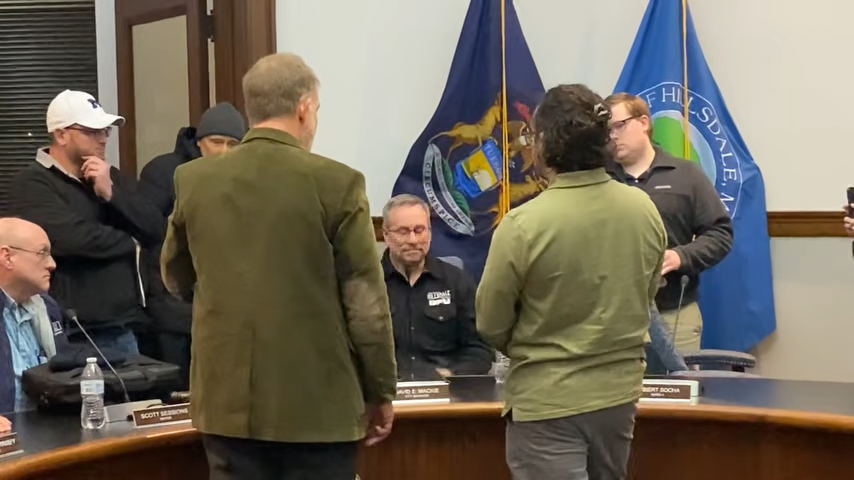
The meeting had already been hastily adjourned.
Most people would assume the real discussion was over. But thanks to a citizen who stayed, recorded the exchange, and preserved what happened next, the public got to hear something far more revealing than the official line. City officials, while insisting nothing had really changed, acknowledged concerns about coverage that cast city government in a negative light, admitted those concerns led to backroom discussions with the college newspaper’s leadership, and confirmed that the relationship had since “moved forward in a positive” way for the city.
That single exchange says more about the state of the press in Hillsdale County than a dozen polished press releases ever could.
This county does not just have a government corruption problem.
It has a free press problem.
A free people cannot govern themselves if the facts are filtered before they ever reach them. That is the real issue now emerging in Hillsdale County. Corruption in our local governments is one problem. But corruption paired with media timidity, editorial filtering, administrative pressure, and open narrative management is far more dangerous.
For months, and in some cases years, residents have watched the same pattern repeat itself. Stories that expose local government in an unfavorable light get softened, delayed, buried, redirected, or never aired at all. Reporters privately admit certain stories will not be approved. Editors refuse to touch issues that reveal corruption. Local Radio repeats official talking points. Student journalists who had begun reflecting real public tension suddenly find themselves pulled into discussions with leadership, after which the tone of coverage changes, remarkably.
Any one example could be dismissed. Together, they form a pattern.
The Collegian and the City’s “Positive” Arrangement
We saw this most clearly in Hillsdale city government.
Last November, we wrote about the mayor’s bizarre new approach to communication, one that treated so-called negativity as something to be monitored rather than tolerated as part of representative government. The mayor wanted council members to copy both him and the City Manager on every email so he could monitor tone. Not misconduct. Not ethics violations. Not misuse of public funds. Negativity.
That was not merely strange. It revealed a governing instinct. Criticism was being treated as a problem to manage. Dissent was being treated as something to supervise. The executive branch was attempting to place itself inside the communications of independently elected officials under the language of professionalism and “chain of command.”
Months later, that same instinct has surfaced publicly in the city’s relationship with the Collegian.
During the exchange that played out after a public meeting, officials insisted there had been no meaningful change in policy. Yet under questioning by multiple councilman after a public meeting was hastily adjourned, that claim began to crack. A citizen who took the time to record the exchange preserved what officials might otherwise have preferred remain vague: city leadership was concerned about stories that cast city government in a negative light, those concerns led to backroom discussions with the college newspaper’s leadership, and the result was a relationship that had “moved forward in a positive” way for the city.
If nothing changed, there would have been nothing to discuss.
If there was no pressure, there would have been no need for leadership intervention.
If there was no problem, there would be no reason to explain why the coverage changed after concerns were raised.
The issue is not whether city government may designate a communications channel. The issue is whether the public is being told the truth about what happened. Officials tried to present the matter as routine. Their own words showed it was not routine at all.
There was conflict.
There was intervention.
There was a worked-out arrangement.
And the result, by their own description, was more positive coverage for the city.
The Wider Pattern Across Hillsdale County
The pattern extends beyond one college newspaper.
The Hillsdale Daily News, once a far more local institution, is no longer rooted in the county the way it once was, it is now based out of Lansing. One local reporter covers Hillsdale County and a neighboring county, and residents have repeatedly heard that certain stories exposing corruption never make it past editors. A Fox reporter who did strong work in Hillsdale encountered similar resistance getting local corruption stories on air. The problem was not lack of facts. It was lack of editorial willingness.
This is what the public keeps seeing:
When coverage flatters government, access is available.
When coverage becomes contentious, the channels tighten.
When facts become inconvenient, editors step in.
When citizens and even local government representatives challenge power effectively, they are labeled negative.
When media protects institutions rather than scrutinizes them, the people are left to govern themselves in the dark.
That is not healthy local journalism. That is a controlled narrative of false positivity and controlling corrected facts.
WCSR and the Clerk’s Narrative
The problem does not stop at city hall controlling college journalists, or the Hillsdale Daily being unable to be half the journalists those students have proven to be.
WCSR has become so brazen in its conduct that residents now openly call it out for functioning less like a watchdog and more like a government propaganda platform. Rather than challenge official claims, it too often repeats them. Rather than test narratives against facts, it reinforces the version most favorable to those in power.
We have already documented one such case involving WCSR using its platform to push corrected facts on behalf of the county clerk. That is not journalism. That is message enforcement.
A press outlet that protects power instead of testing it is not serving the public. It is serving the system and WCSR is proud to serve our corrupt local governments.
What Goes Underreported Here
This information problem is not happening in a vacuum. It is unfolding in the middle of one controversy after another in Hillsdale County, many of them involving public trust, public money, election administration, local development, special assessments, and the conduct of public officials. Yet the only time some of these matters receive meaningful public exposure at all is when an outlet from outside the county briefly notices them and does a short overview before moving on.
Residents of this county have watched serious controversies stack up for years while the institutions supposedly responsible for informing the public too often ignore them, soften them, delay them, or approach them only from the safest possible angle. Controversies involving the county clerk and election administration have generated public outrage, courtroom testimony, criminal proceedings, and ongoing citizen scrutiny. The LifeWays bond issue and the commissioners’ handling of it triggered major backlash, allegations of insider dealing, and deep public concern over who exactly county government is serving. Fayette Township’s solar fight has raised major questions about land use, local control, and the future of rural communities. The Adams Township election matter is still in court after the unlawful warrant that brought it before a judge was dismissed after the County Clerk admitted to violating State and Federal election laws . In city government, residents have watched growing conflict over the road diet, special assessment districts, the Keefer project, and the broader treatment of dissenting voices. And then there is the Dawn Theater, a project tied to millions in public support that still is not operating as many residents were led to expect.
That alone would be troubling. What makes it worse is that the public often gets more honest acknowledgment of these controversies from outside the county than from the outlets operating inside it. Time and again, the only moment a major local dispute receives meaningful exposure is when an out-of-county reporter or regional outlet briefly notices the story, summarizes the controversy, and then moves on. Even when that coverage is incomplete, its very existence highlights the failure closer to home.
A healthy local press should not require outside intervention to tell residents that serious controversies exist in their own county. Yet in Hillsdale, that has become increasingly common.
When Outsiders Cover What Insiders Won’t
Time and again, the only meaningful acknowledgment that a serious local controversy even exists comes not from the institutions living in the middle of it, but from someone outside the county who notices the smoke long enough to mention the fire.
Consider just a few examples. The LifeWays bond controversy drew outside television coverage when regional outlets briefly reported on the public backlash, the proposed bond, and the meeting chaos that followed. Fayette Township’s solar fight also broke through to outside coverage, as did the Adams Township election matter that is still working its way through court. In city government, the road diet made regional news. The Keefer project received outside attention. Even the Dawn Theater, despite millions in taxpayer-backed public investment and the obvious public interest in its failure to operate as promised, stands as another example of how major local controversies can persist with little meaningful sustained scrutiny.
Some of the most meaningful outside coverage of Hillsdale controversies came from Fox 47 reporter Darius Udrys. He is no longer serving in that reporting role, and residents have experienced exactly what often happens when a serious reporter disappears from a beat: less follow-up, less engagement, and less pressure on the institutions that most need scrutiny. The reporter now assigned to Hillsdale has been difficult to reach, and residents have increasingly found that the brief outside attention Hillsdale once received is now even harder to sustain. That matters, because when local outlets fail and outside outlets stop following through, corruption does not disappear. It simply becomes easier to hide.
That is the real point. A healthy local press should not require outside intervention to tell residents that serious controversies exist in their own county. Yet in Hillsdale, that has become increasingly common to the point it is normal. The only time many residents see honest acknowledgment of what is happening around them is when an out-of-county outlet briefly notices the story, summarizes the controversy, and then moves on. Even when that coverage is incomplete, its very existence exposes the silence closer to home.
If the only time a major controversy in Hillsdale County receives meaningful public attention is when someone from outside the county happens to notice it, then the failure is not one of geography.
It is one of duty.
What a Free Press Actually Is
This should not need saying, but clearly it does.
A free press is not a public relations department. It is not a morale office. It is not there to reduce “negativity,” preserve civic calm, or soften conflict so local officials can maintain a more favorable public image. It is not there to protect the mayor, the city manager, the county clerk, township boards, county commissioners or any other officeholder from scrutiny.
Its duty is to the people. And thanks to a few intrepid college journalists who understood that duty and have unfortunately been ordered to report on corrected facts, this pattern that has plagued Hillsdale County for years is now able to be exposed.
A free press exists to inform the public truthfully, scrutinize power honestly, expose misconduct when misconduct exists, and give citizens the facts they need to govern themselves. It is supposed to reveal why there is friction between government and the governed, not smooth that friction away so the public sees less than it should.
The purpose of a free press is not to make government look good.
It is to make government answer questions. Not report on corrected facts.
Bias Is Not the Issue
Some will respond with the usual excuse: objectivity is impossible. Every outlet has bias. All reporting is shaped by perspective, corrected facts.
Fine.
Bias is not the issue. Dishonesty is.
Perspective is not the issue. Suppression is.
A press outlet can have a point of view and still function honestly. It can acknowledge its bias and still tell the truth. It can be opinionated and still investigate power. It can openly state where it stands and still present facts, quote public officials accurately, document contradictions, and show the public what is happening.
We know this because we do it here all the time.
That is the excuse institutional outlets rely on when they no longer wish to do their jobs. They hide behind the impossibility of perfect neutrality as though that somehow justifies silence, omission, or cowardice. It does not. The public is better served by an outlet that admits its viewpoint and tells the truth than by one that performs neutrality while quietly filtering corrected facts for those in power.
The issue is not that bias exists.
The issue is that bias is being used as an excuse for cowardice and control.
The Question Every Outlet Must Answer
So let us ask the question plainly:
Who does a free press work for?
Local government officials trying to manage public perception?
Advertisers who prefer comfort over controversy?
Editors with private agendas they refuse to disclose?
Or the people of this county, who are trying to understand the place they live and expect honest news about it?
A free press does not work for the mayor. It does not work for the city manager. It does not work for the county clerk, commissioner or township board. It does not work for advertisers, institutional relationships, or editors protecting access.
It works for the public.
Its duty is to the people who must live under the decisions being made, who pay for them, who suffer under corruption when it exists, and who need truthful information in order to govern themselves.
The moment a press outlet begins treating the public as a problem to be managed rather than a citizenry to be informed, it has abandoned its first duty. (Does this sound familiar)
Our Answer
That is the challenge before every outlet in Hillsdale County now:
Who exactly are you serving?
We here at the Hillsdale Conservatives already know our answer.
We serve the people of Hillsdale County.
That is our bias.
Our bias is toward the resident trying to make sense of corrupt government, dishonest narratives, and institutions that too often protect power instead of exposing it. Our bias is toward truth plainly told, facts openly examined, and a public treated like neighbors instead of an audience to be managed.
We do not apologize for that bias.
We are proud of it and proudly conservative.
We would rather be openly biased toward the people seeking answers than secretly biased toward those in power who frame questions as negativity and demand their corrected facts take precedent over the whole story that clearly casts our local governments in a negative light.
The real heroes in this story are the student journalists who were willing to ask the hard questions in the first place. They were doing what too many adults in this county have stopped doing. They were paying attention. They were pressing for answers. They were helping give the public something increasingly rare in Hillsdale County: more of the whole story.
That deserves encouragement, not correction.
It is a shameful thing when the adults in a community fail to uphold the standards of a free press and instead teach the next generation that truth must be softened, controversy must be managed, and facts must be “corrected” whenever corrupt government finds them inconvenient. That is not journalism. That is conditioning.
The people of Hillsdale County do not need young reporters trained to protect power. They need young reporters encouraged to question it. They need journalists willing to keep digging, keep asking, and keep telling the public what those in authority would rather leave unsaid.
So let the record show that our support is with the students who tried to do the job honestly. They deserve respect for their courage, gratitude for their work, and encouragement to keep going. If there is any hope for a real free press in this county, it will come from those still willing to tell the whole story, even after the adults have tried to teach them not to.
May the next generation of journalists in Hillsdale learn to fear the truth less than the adults who tried to manage it.
in liberty,
Lance Lashaway


Leave a Reply