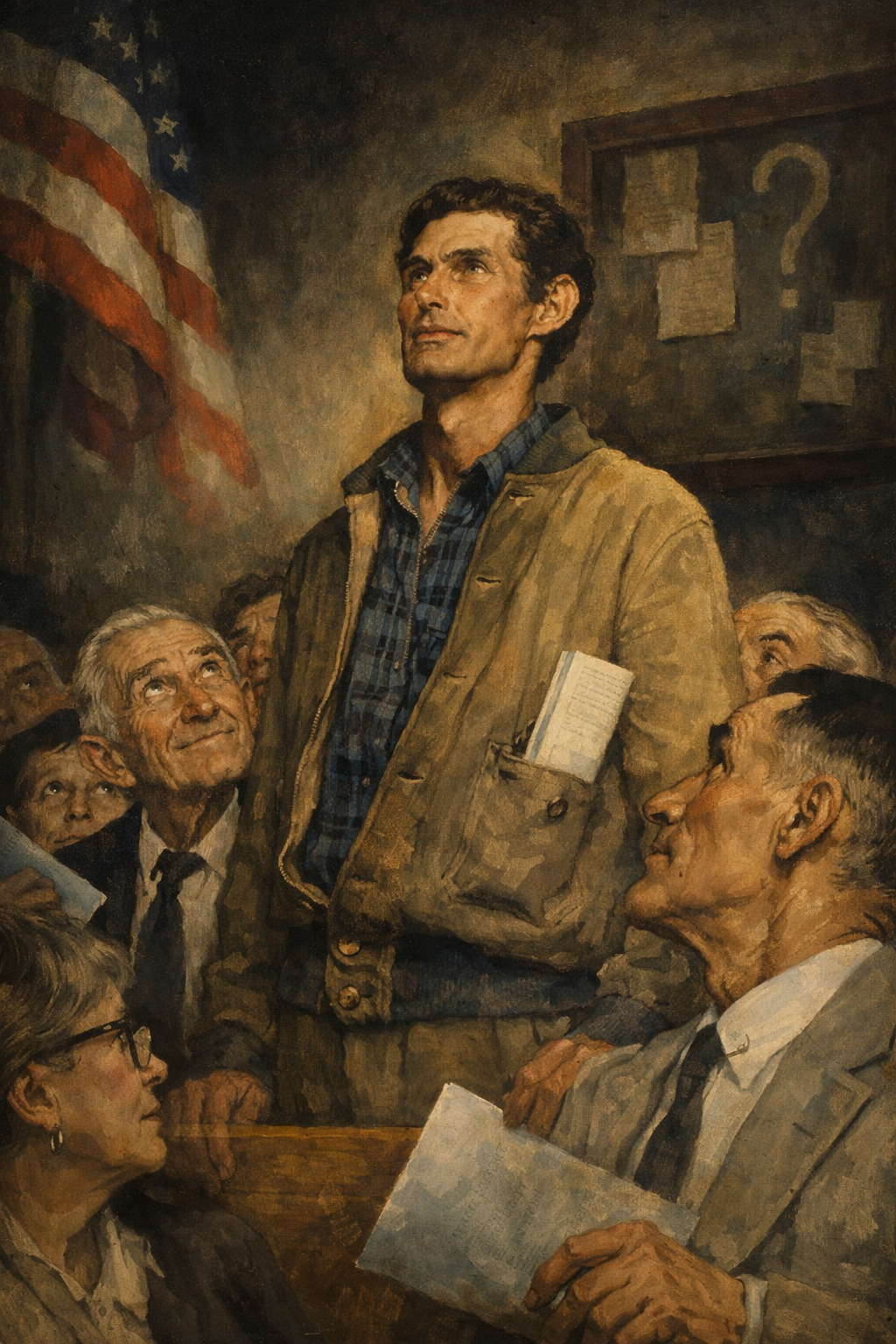
Why the national turn matters, and why Hillsdale County now has to face itself.
THE HILLSDALE CONSERVATIVES
Truth • Liberty • Local Stewardship
• Hillsdale County, Michigan • March 15, 2026 • 2¢
Editor’s Note: This is not a five-second TikTok.
If you are reading this, you already understand something our society keeps trying to train out of people: some things take time. Some things require memory. Some things require following the line from cause to consequence, from national decay to local corruption, and from public slogans to the reality underneath them.
That is what this piece is about.
It is longer than usual because the subject is larger than usual. If a country drifts for fifty years, certainly its states and counties drift with it, the truth about that decline is not going to fit inside a sound bite.
What follows shows a connected undeniable theme.
The first is the American story: how this country changed its posture over the last fifty years, how strength gave way to drift, how sovereignty gave way to management, and why the return of an America First vision matters for the people government was supposed to serve all along.
The second is the story of the past year: the concrete steps taken to begin reversing that decline, not just in rhetoric, but in policy, priorities, borders, trade, energy, law, and the basic idea that the American government should once again act like it belongs to the American people.
The third is the local story, and in some ways the hardest one: Hillsdale County. More and more residents in one of the most conservative counties in Michigan have been forced to confront an uncomfortable truth. We were not exempt from the same habits that hollowed out the country. We simply saw them arrive here in a more familiar form, under conservative branding, behind handshakes, titles, and the old assumption that because this place said the right things, it must also be governed the right way.
That assumption is breaking.
The township fights. The solar fights. The city road and special assessment debacles. The county clerk scandal. The LifeWays scandal. The Keefer and Dawn controversies. The sheriff questions. The years-long battle over what belongs in the children’s section of the city library. None of these are as isolated as they first appeared. Taken together, they tell a larger story about what happens when a place believes its reputation will protect it longer than its institutions deserve.
That is why this article is long.
It needs to be.
Because if we are going to speak plainly about what has happened to the country, what has begun changing, and what Hillsdale County now has to face about itself, the short version is not enough.
The National Correction
For the last fifty years, America’s place in the world has gone through a dramatic transformation.
There was a time when the United States projected unmistakable strength. Our allies trusted us, our enemies feared us, and the world understood that American power meant order, deterrence, and consequences. Then came a long era of drift. Washington grew addicted to half measures, endless interventions, global charity without accountability, and elite foreign policy theories that often seemed more concerned with the approval of international institutions than the safety and prosperity of American citizens.
That era did not just weaken America overseas. It weakened confidence at home.
An America First view begins with a simple principle: the United States government exists first to protect the American people, defend American sovereignty, preserve American prosperity, and advance American interests. Not to subsidize every foreign government. Not to manage every global dispute. Not to apologize for American strength. And not to allow hostile regimes, terror networks, or foreign influence operations to threaten our country while our leaders pretend restraint is the same thing as wisdom.
Over the last fifty years, America has moved through three major phases.
The first was the old Cold War understanding of strength. The United States acted like a serious civilization. Borders mattered. National identity mattered. Military supremacy mattered. Enemies were confronted from a position of overwhelming advantage.
The second was the age of global management. America was still powerful, but its political class increasingly used that power without discipline. We spent treasure, lives, and political capital trying to rebuild foreign societies while neglecting the foundations of our own. Our leaders often acted as though American strength existed to stabilize the whole planet, even when the American middle class was paying the bill and seeing little return.
The third is what we are entering now: a return to selective strength. That is the America First model. It is not isolationism. It is not passivity. And it is not nation building. It is a doctrine of hard realism: do not surrender your interests, do not tolerate threats forever, do not subsidize your enemies, do not invite chaos into your own country, and when force is necessary, use it decisively and with a clear objective.
America First does not mean America absent. It means America serious.
For years, the political establishment sold the public two false choices. Either America had to be the world’s police officer, endlessly entangled in foreign occupations and open-ended missions, or America had to retreat entirely and let hostile powers fill the vacuum. But those were never the only options. There is a third option: defend American interests ruthlessly, avoid permanent occupation, and restore deterrence so enemies think twice before acting against us.
That posture benefits ordinary Americans in real ways.
First, it reduces the chance of larger wars. Weakness invites escalation. Hesitation invites testing. Confused leadership encourages hostile regimes to believe America no longer has the will to act. A strong, credible United States is not more likely to produce chaos. It is often the only thing preventing it.
Second, it restores respect for American citizens. For too long, Washington asked working Americans to sacrifice for abstract global causes while ignoring their own declining security, stagnant wages, broken borders, and cultural demoralization. America First reverses that moral order. It says the truck driver in Michigan, the welder in Ohio, the rancher in Texas, and the mother raising children in a struggling town matter more than the ambitions of foreign bureaucrats, transnational activists, or corrupt overseas regimes.
Third, it recognizes that foreign policy and domestic policy are no longer separate. A nation that cannot control its border cannot protect its future. A nation that imports people with no expectation of assimilation eventually imports conflicts that were never supposed to be here. A nation that tolerates ideological hostility inside its own institutions will find that foreign threats are no longer just overseas. They show up in politics, media, education, and the streets.
That is one of the biggest shifts in the modern era. America is learning that weakness abroad and weakness at home feed each other.
When a government looks indecisive overseas, hostile actors notice. When immigration policy is unserious, radicalism finds entry points. When leaders refuse to name real civilizational differences, citizens are told to ignore patterns that are plainly in front of them. America First rejects that dishonesty. It insists that national cohesion matters, assimilation matters, loyalty matters, and citizenship must mean more than possession of paperwork. A nation is not a hotel. It is a people, a culture, a history, and a shared inheritance.
That is why so many ordinary Americans support a more forceful worldview now than they did a generation ago. They are tired of being told that every act of strength is reckless, while every act of weakness is enlightened. They are tired of watching Washington fund instability, excuse enemies, and lecture citizens about democracy while ignoring the simplest duty of government: protect your own people first.
An America First approach does not celebrate chaos. It celebrates order.
It does not glorify war. It recognizes that credible force prevents worse wars.
It does not seek empire. It seeks advantage.
And it does not ask American families to carry the burdens of the world while their own communities decline.
For fifty years, America drifted between overreach and hesitation. What many conservatives now want is neither. They want clarity. They want strength with purpose. They want peace through deterrence. They want a government that fears disappointing its own citizens more than offending foreign elites. And they want to live in a country that once again understands the difference between compassion and surrender.
That is the real argument for America First.
Not that America should do everything.
Not that America should do nothing.
But that America should act in a way that unmistakably serves Americans.
And after decades of confusion, many people are ready for exactly that.
The Turn of the Past Year
That change did not happen by accident. It did not happen because the world suddenly became kinder, foreign regimes suddenly became reasonable, or the American ruling class rediscovered restraint on its own. It happened because the Trump Administration made a deliberate decision to reassert a principle that had been missing for years: the United States government is supposed to act on behalf of the United States.
The shift began with something more fundamental than any one military strike, tariff announcement, or immigration order. It began with a governing doctrine. Border first. Sovereignty first. Energy first. Worker first. Security first.
That matters because the real difference over the past year is not simply that different decisions were made. It is that a different order of priorities was restored. Previous administrations often behaved as though America’s strength existed to stabilize the whole world, even when that meant draining American resources, weakening the border, tolerating trade imbalances, and subordinating our own workers to abstract global management. The America First approach reversed that. It said plainly: America does not exist to be used. America exists to endure, to prosper, and to protect its own people.
That change could be seen first and most clearly at the border.
The southern border was treated again as a sovereignty issue, not a humanitarian slogan and not a paperwork exercise. Immigration and national security were put back together. Foreign aid was no longer treated as a sacred flow of money detached from American interests. International bodies were no longer treated as untouchable simply because they called themselves international. Trade was once again treated as an instrument of national power. Energy was treated as national strength. Election integrity was treated as part of sovereignty. And law, order, and civilizational confidence were restored as legitimate concerns of government rather than dismissed as relics of an older America.
That is why the country has begun to feel different.
Not because one speech changed everything. Not because one press release solved every problem. But because the machinery of government was being reordered around a proposition that had been missing for too long: the American people are not an afterthought.
The past year mattered because it reminded citizens what government looks like when it acts like it belongs to its own country again.
It was not branding.
It was not theory.
It was action.
The Local Test in Hillsdale County
That brings the question home.
Because it is one thing to talk about how America has changed its posture in the world. It is another thing entirely to ask whether that same return to sovereignty, accountability, and common sense has reached the local level. And in Hillsdale County, that question cuts deeper than many people want to admit.
For years, many residents assumed this county was safe.
They assumed that because Hillsdale County is known as the most conservative county in Michigan, it would be naturally protected from the rot that spread across so much of the country over the last fifty years. They assumed corruption was a big-city problem. They assumed backroom governance was something that happened in blue counties, not here. They assumed public debt schemes, insider protection, manipulated narratives, election irregularities, and government contempt for ordinary residents were the habits of the old machine elsewhere, not the habits of people claiming to represent conservative rural America.
That illusion is breaking.
What an ever-growing number of local residents have discovered is something far more sobering: a county can use conservative language while operating by the exact same corrupt instincts that have hollowed out the country for decades. It can wave the right flags, say the right slogans, attend the right dinners, and still govern in a way that is not America First, not taxpayer first, not family first, not truth first, and certainly not constitutional first.
That is the real local story now unfolding in Hillsdale County.
Because what has been growing here for years is not one isolated controversy. It is a pattern. The townships, Hillsdale City Council, the County Commissioners, the county clerk election scandal, the LifeWays scandal, the solar fights, the special assessment and road debacles, the Keefer issue, the Dawn issue, the years-long library fight over what belongs in the children’s section, and the frustration over a sheriff’s office that too often appears to protect the system instead of confront it are not random disconnected events. They are different faces of the same disease.
The disease is local managerial corruption dressed in conservative clothing.
It is the belief that the public exists to be managed, not represented.
It is the belief that ordinary citizens may be tolerated, but not obeyed.
It is the belief that public office is a shield for insiders, not a trust held on behalf of the people.
It is the belief that language like “for the good of the community” can be used to cover debt, conceal incompetence, override public opposition, and punish anyone who notices.
Because the people now pushing back in Hillsdale are not radicals. They are not anarchists. They are not anti-government. They are the very people who believed in this county most deeply. They believed Hillsdale was different. They believed conservatism here meant stewardship, honesty, local control, sound elections, sound roads, responsible development, transparent government, and law applied evenly. Instead, what they found in too many places was something much more familiar to the broader American story: entrenched personalities, closed circles, selective enforcement, narrative management, and a political class that grows irritated the moment citizens begin asking direct questions.
That is not conservatism.
That is broken local governance at best, malicious corruption at worst.
The solar battles made this visible in some of the clearest terms. Residents in township after township began realizing that what was being sold as progress or economic opportunity was often something else entirely: outside interests, favored developers, legal pressure, manipulated zoning assumptions, and a steady attempt to turn productive rural land into something the people living there never asked for.
The same dynamic surfaced in Hillsdale City. The road fights, the special assessment controversies, and the recurring sense that residents were being maneuvered rather than heard all exposed a deeper problem. Citizens were not simply debating asphalt, budgets, or financing methods. They were confronting a governing attitude that too often treats taxpayer resistance as a nuisance rather than a legitimate boundary.
Then there is the county clerk issue. No truly conservative county can afford an election scandal. Once public confidence in election administration is damaged, every other institution begins to take on the same haze of doubt. People begin asking the question they never wanted to ask: if they mishandled this, what else have they mishandled?
The LifeWays controversy brought the whole disease into even sharper focus. Here the public saw what so many Americans have seen at every level of government for years: a politically connected structure advancing a major public-facing proposal with weak public trust, weak public explanation, and growing suspicion that the real decisions had already been made before the public was ever seriously brought into the conversation.
The Keefer and Dawn debacles fed the growing suspicion that Hillsdale County and its municipalities have too often drifted into a culture where outcomes are shaped as much by relationships, narratives, and power alignments as by neutral principle.
The library fight belongs in this story too, because it has exposed the same governing instinct now visible across so many local controversies: ignore the public, repackage the issue, elevate insiders, and then punish dissent when someone objects out loud. What belongs in the children’s section of a city library should not be a radical question in a county like this. It should be one of the easiest questions in the world. Children’s spaces are for children. Adult content belongs somewhere else. Parents have a right to expect age boundaries. Citizens have a right to voice concerns when those boundaries are ignored.
Yet even this fight has been reignited through insider appointments and legal threats against a councilman for reading an email and forming a public opinion.
And then there is the sheriff question.
Perhaps nothing poisons a county faster than the belief that law enforcement protects the political structure rather than the people. When people begin to believe that the sheriff covers for entrenched interests, looks away from politically useful wrongdoing, or shows more concern for preserving the local machine than confronting it, the damage goes beyond one office. It teaches the public a devastating lesson: the system investigates enemies, but protects friends.
That is the bigger realization now spreading through Hillsdale County.
The most conservative county in Michigan is not safe simply because it is conservative by reputation.
A county is not protected by its slogans.
It is protected by the character of its institutions and those who are elected to serve and represent the owners of those institutions.
And when those institutions are left unattended long enough in the hands of those unwilling to listen, the same corruption that hollowed out the rest of the country begins appearing here too. Not always in the same scale. Not always in the same language. But in the same spirit.
It comes in the form of insiders who expect obedience.
It comes in the form of debt sold as necessity.
It comes in the form of elections that raise serious questions.
It comes in the form of development pushed against local resistance.
It comes in the form of selective enforcement.
It comes in the form of public bodies that increasingly behave as though scrutiny itself is the offense.
It comes in the form of appointments used to reopen controversies the public never asked to relive.
And it comes in the form of people in power betting that local residents will tire out before the truth becomes undeniable.
That corrupt “order” is beginning to fail.
Because an ever-growing local movement has formed around the realization that Hillsdale was not exempt. It was not insulated. It was not magically protected from the decay that spread through American institutions over the past fifty years. It simply experienced that decay in a more rural accent, under more conservative branding, and behind a thicker layer of local familiarity.
Now that layer is wearing thin.
The people pushing back are not merely fighting over one bond, one election, one zoning fight, one road plan, one city dispute, one library appointment, or one county controversy. They are fighting over whether Hillsdale County will continue down the same path as the country it claims to oppose, or whether it will finally become what it has long said it already is.
That is the local test.
And in many ways, that test is more important than the national one.
Because it is easy to condemn corruption in Washington.
It is harder to confront it when it lives down the road, sits on a local board, shakes hands at public events, speaks the language of conservatism, and assumes no one will dare name what it has become.
But more people are naming it now.
And that is how real reform begins.
The Question Is No Longer Whether People See It
The first part of this article looked at the national story, how America drifted over the last fifty years, and why the return of an America First posture matters. The second walked through how that change began to take shape over the past year through concrete action, not just slogans. The third brought the question home to Hillsdale County, where more and more residents have been forced to confront the same hard truth: conservative language is not the same thing as conservative government.
That is the thread running through all of this.
It is the same thread running from Washington to the township hall, from the border to the boardroom, from national decline to local arrogance. The names change. The scale changes. The setting changes. But the habit is the same. Insiders protect insiders. The public is managed. Objection is treated as inconvenience. Common sense is treated like disruption. And the people footing the bill are expected to sit down, stay quiet, and be grateful for whatever version of events they are handed.
That is not America First.
That is not taxpayer first.
That is not parent first.
That is not local control.
And that is not conservatism.
Real conservatism does not hide from the people. It does not fear transparency. It does not use process as camouflage for contempt. It does not build public policy around insider appointments, managed narratives, selective enforcement, and the assumption that regular citizens will eventually get tired and go home.
That assumption is failing.
More people see it now.
More people are saying it out loud.
And more people are realizing that Hillsdale County will not be cleaned up by reputation alone. It will only be cleaned up when the people who have carried this county for years decide that enough really is enough, and then act like it.
So act like it.
Come to the Hillsdale County Board of Commissioners meeting on Tuesday, March 24, 2026, at 9:00 a.m., now to be held at Hillsdale City Hall because the commissioners meeting room was not big enough to hold all the people tired of a county government that does not seem interested in listening to the very people it represents.
Come because if they will not make room for the public on their own, the public should make its presence impossible to ignore.
Come because 9:00 a.m. on a weekday is not a reasonable time for most working taxpayers, and the people who pay for county government should not have to rearrange their lives just to be heard by it.
If Hillsdale County is going to become what it has long claimed to be, then this is the work.
Not the slogans.
Not the branding.
Not the speeches.
The work.
Be there.
In liberty,
Lance Lashaway

The Battle for Michigan’s Middle Ground: Bonus Round
If you made it this far, you already know the local story does not stop at the county line.
Between Washington and Hillsdale sits Lansing. And if the national story over the last fifty years was one of drift, while the local story in Hillsdale has been one of corruption wrapped in conservative language, then the Michigan story has too often been one of managed decline. Lansing has increasingly acted as the middle layer between national ideology and local compliance. It has taken big national priorities, translated them into state policy, and then expected local communities to absorb the consequences. That pattern shows up clearly in energy policy, where Public Act 233 gave the Michigan Public Service Commission siting authority over utility-scale wind, solar, and storage projects under certain conditions, weakening the practical force of local resistance.
The same instinct has shown up in the state’s corporate-subsidy culture. Michigan’s SOAR program became one of the clearest examples of Lansing’s preference for politically managed economic development, where public money moves first, insider promises come next, and taxpayers are told to trust the process. By October 2025, Whitmer’s proposed $2 billion expansion of that model was killed after rising scrutiny and skepticism over transparency and results.
That is the Michigan layer in this story. Not quite Washington. Not quite Hillsdale. But the place where national priorities are turned into state mandates, grant structures, pressure campaigns, and managed compliance.
And yet, for all of that, the line has not disappeared.
If anything, one of the more encouraging parts of the Michigan story is that despite the obstacles put up by a Democrat governor, there are still men in Lansing working to slow the damage, expose the system, and in some places push it backward. That matters in Hillsdale County too.
One of the clearest examples is the LifeWays fight. In March 2026, both state senators whose districts include parts of Hillsdale County, Jonathan Lindsey and Joe Bellino, publicly said the proposed LifeWays building bond should go to the voters. Bellino said he supported letting the people decide. Lindsey said the bond was too risky and too long a commitment to be decided unilaterally by the Board of Commissioners and should be voted on by the people. That is a rare thing for one senator to do in a county-level dispute, let alone two. And they did it on the side of the people of Hillsdale County against the idea that a major long-term obligation should simply be rammed through by commissioners refusing to listen to the residents they represent.
That is worth pausing on.
It does not mean Lansing is fixed. It does mean the line is still being held.
Bellino has also backed legislation to restore more local control over renewable-energy siting, while Senate Republicans have framed those efforts as a pushback against state-driven energy mandates.
You do not have to agree with every bill, every tactic, or every personality to see the larger point. The state is not fully lost. It is contested.
And that matters.
Because in a place like Michigan, where the governor’s office still speaks the language of centralized planning, managed outcomes, and polished public messaging, there is real value in legislators willing to throw sand in the gears, defend local control, resist subsidy politics, raise election and accountability questions, and remind Lansing that the people below it are not livestock to be processed.
That is not yet full recovery.
But it is holding the line.
And in some places, it is the beginning of pushing back.
So while Hillsdale County has every reason to clean its own house, residents should not miss the larger state lesson either. Local reform gets much harder when Lansing is moving in the opposite direction. But it gets much more possible when there are still men in the state Capitol willing to resist the drift, even if only a handful at a time.
That is why names like Jonathan Lindsey, Joe Bellino, Steve Carra, Matt Maddock, Jim DeSana, and others matter.
Not because any one of them is going to save Michigan by himself.
But because in an age of managed decline, even holding the line matters.
And when enough people hold the line long enough, the line starts to move.
Leave a Reply