THE HILLSDALE CONSERVATIVES
Truth • Liberty • Local Stewardship
• Hillsdale County, Michigan • Week of March 3, 2026 • 2¢
This week brought another reminder that conservatives do not need perfect conditions to gain ground. They just need enough people willing to notice what is happening, say it out loud, and keep pressing where it matters. From township hearings to county backlash to a renewed fight for constitutional carry in Lansing, the pattern is getting harder to ignore: the old script is wearing thin, and more people are no longer pretending otherwise.
Across Hillsdale County, the same pattern kept showing itself: citizens showed up, officials tried to manage the fallout, and the political class kept discovering that once people begin paying attention, old tricks stop working as well. In township government, the battle over renewable energy zoning is now fully out in the open. In the city, the roads issue remains unresolved because residents have plainly rejected the old special-assessment model. At the county level, the Lifeways bond controversy has grown from a finance dispute into a test of whether the public still has any meaningful say at all. And at the state and national levels, the old establishment language of delay, caution, and managed decline keeps losing ground to a harder, more openly conservative mood.
That matters.
Because what is happening in Hillsdale is not isolated. It is local, yes, but it is also representative. This is what it looks like when a county stops mumbling its objections and starts speaking clearly.
And once that happens, there is no real going back.
Local Township
Fayette Township heads into a consequential public hearing on energy zoning
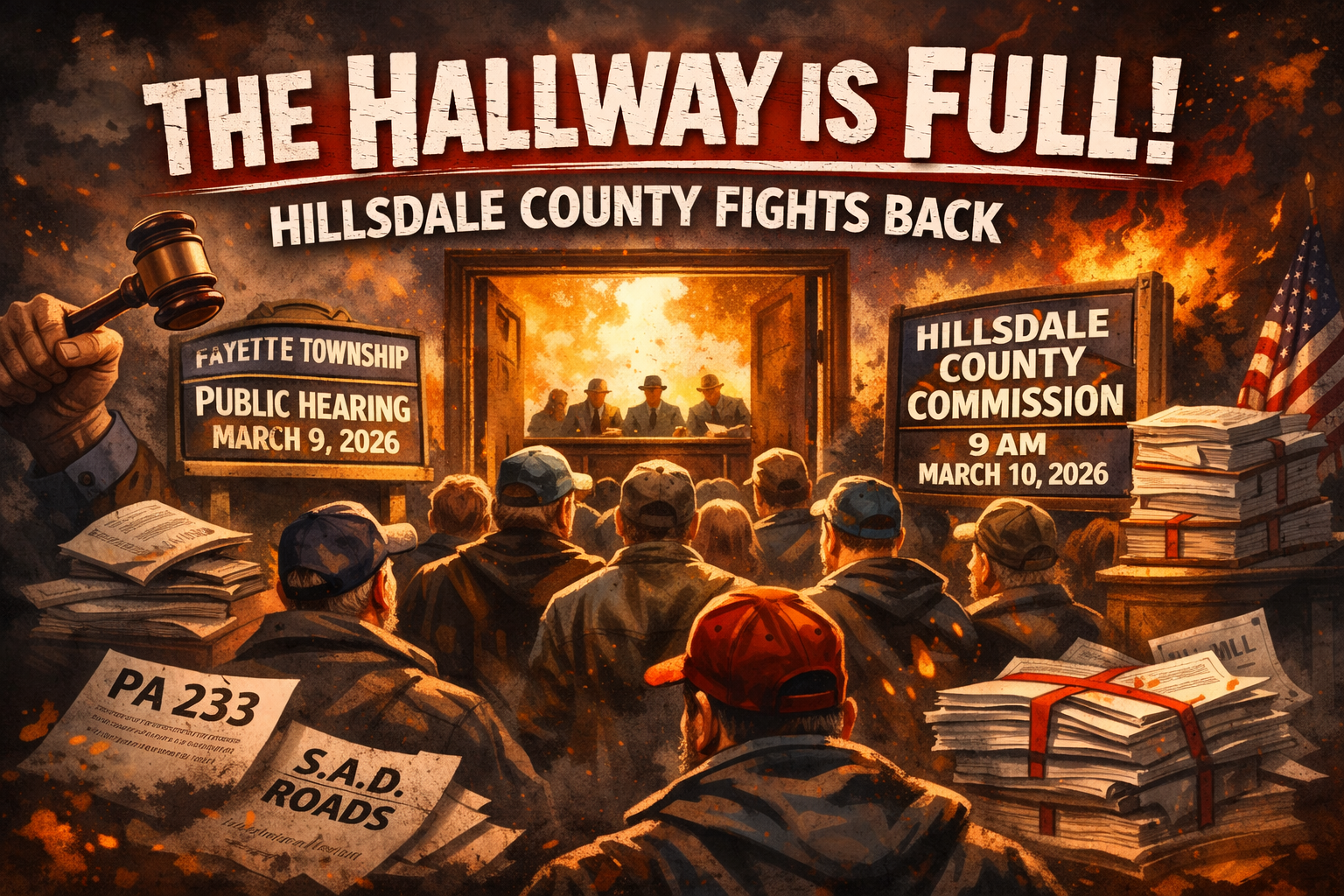
Fayette Township’s Planning Commission has scheduled a public hearing and special meeting for Monday, March 9, 2026, at 7:00 p.m. at the Jonesville Middle School Wright Street gym to consider major zoning text amendments tied to a so-called compatible renewable energy ordinance.

That phrase sounds tidy and harmless. The actual substance is not.
The proposed ordinance changes would add and revise definitions, repeal existing sections tied to solar and wind energy systems, create a new zoning structure for regulating energy facilities, establish an application process, require specified materials and supporting plans, impose setback and height standards, address energy storage, require a decommissioning plan, and introduce rules touching environmental and wildlife protections, host agreements, and severability. A separate zoning amendment would also define the duties of the township zoning administrator.
That is not a minor clerical update. That is a full framework fight.
This is how these battles are usually packaged. The public is told this is merely process. The draft language is long, technical, and bureaucratic. The hearing is set, the paperwork is posted somewhere, and citizens are expected either not to notice or not to understand the long-term implications until the structure is already in place. Then, once the framework is adopted, everyone is told the real options are limited because “the ordinance already says” what can and cannot be done.
Hillsdale County has seen enough of that style of governance.
The notice makes clear that copies of the proposed text amendments are available through the township and online, and written comments may be submitted until 4:00 p.m. on the date of the hearing. That gives residents a narrow but real opportunity to read the language, prepare, and show up ready to speak with precision.
They should take it.
Because this is one of those meetings where the phrase local control either means something or it does not. If the township is going to shape its own future, this is the moment to prove it. If not, then local government will simply become the staging ground where outside priorities are translated into local paperwork and sold back to residents as inevitability.
The good news is that people are not asleep. The notice is out. The meeting is set. The issue is public. The public now has a chance to respond before the framework hardens.
Fayette Township Planning Commission Public Hearing
Monday, March 9, 2026
7:00 p.m.
Jonesville Middle School Wright Street gym
Show up. Read the ordinance. Speak plainly.
Hillsdale City
Roads, speech politics, and one ordinary zoning vote in a city still looking for a governing center
At Monday night’s Hillsdale City Council meeting, three issues defined the evening: the unresolved road funding problem, the council’s rejection of a speech-policing settlement resolution, and a rezoning approval that briefly reminded everyone what normal local government is supposed to look like.
City Hall still has no credible replacement for a failed road policy
The most practical issue in the room was still roads.
That has been true for months, and the city still does not appear to have a politically workable replacement for the special assessment district model that residents have repeatedly rejected. Council discussed alternatives, frustrations surfaced again, and a motion to suspend the SAD requirement through the 2026 election failed. So the city remains stuck in the same position it has drifted in since the policy broke apart in public view: the roads need repair, the people do not want the old financing mechanism, and the governing class still seems to think more procedural circling might somehow solve the political problem.
It will not.
The core fact here is simple. Residents are done with SADs. Not “concerned about” them. Not “asking for better messaging” on them. Done. The city can dislike that answer, but it is still the answer. And every meeting that passes without a durable alternative only reinforces the impression that City Hall spent years building a policy framework the public never actually accepted.
That matters because roads are not a symbolic issue. They are not a culture-war abstraction. They are one of the clearest tests of whether a local government can perform its basic duties without falling back on bad policy and public scolding. Right now, Hillsdale has the problem fully identified and the old answer politically dead. What it does not yet have is a replacement serious enough to rebuild trust.
The positive development is that the public is now speaking in plain English. There is no ambiguity left. People are no longer whispering around the edges of the problem. They are forcing it into the open, and that is the first real step toward breaking the old pattern.
Council rejects settlement resolution in Moore/Paladino dispute
Council also rejected the proposed settlement resolution tied to the Eric Moore / Josh Paladino dispute by a 6-2 vote.
That vote mattered beyond the personalities involved.
Opponents argued the resolution language was vague, unnecessary, and dangerous as precedent. And they were right to worry. Local government cannot function in an atmosphere where every harsh disagreement is treated as a trigger for collective public repentance. Councils are supposed to govern, debate, disagree, and take positions. They are not supposed to become therapeutic compliance circles where every controversial remark produces a formal ritual of managed apology.
That is how government gets softer, weaker, and less honest.
Hillsdale did not solve every tension Monday night, but it at least refused to establish a standing precedent that political conflict must now be translated into speech-monitoring resolutions. In this climate, that counts as a small but real institutional immune response.
Rezoning approved for South Broad laundromat project
Council also approved rezoning for 120 South Broad Street to allow a laundromat project to move forward. No objectors were noted during the discussion.
That may seem minor compared with the louder controversies, but it was worth noticing precisely because it was ordinary. It was a reminder that local government can still process a land-use question, hear no objection, make a decision, and move on without turning the whole affair into a civic melodrama.
Frankly, after the last several years, normal is underrated.
So the city story this week is straightforward: Hillsdale still has a real roads problem with no convincing answer from City Hall, it wisely rejected a bad speech-precedent resolution, and it managed one clean zoning action without collapsing into theater. That may not sound glamorous, but in municipal politics it is a more revealing snapshot than most headlines.
County Commissioner
The Lifeways bond fight is now bigger than the bond itself
The February 24, 2026 Hillsdale County Commission meeting made one thing unmistakably clear: the Lifeways controversy is no longer just a dispute about bond structure or financing theory. It has become a much larger fight over trust, process, public voice, and whether county government still understands who it works for.
The meeting drew a major crowd. The room filled. The hallway filled. Citizens lined up and spoke for hours. Speaker after speaker pressed the same central objections, often in different language but with remarkable consistency: the county should not act as a bank for an outside entity; the public should not be placed behind a major financial risk without a vote; the explanations for the maneuvering have shifted; and the process looks less like transparent governance than insider coordination wrapped in procedure.
That is the substance. And it was not expressed by one faction or a single personality. It came in a broad wave.
Residents argued that local banks had not been willing to finance the project on favorable terms and asked the obvious question: if lending professionals do not want to hold that risk, why should county taxpayers stand behind it instead? Others emphasized what a default or missed payment could mean in practical terms, pointing to roads, parks, law enforcement, courts, and other county responsibilities that could be squeezed if things went sideways. Several speakers challenged the ethics and optics surrounding overlapping roles, inside communications, and the overall handling of the issue. Others focused more broadly on representation itself: if voters are the ones who may ultimately bear the burden, then voters should not be treated as spectators to the decision.
It was one of the clearest moments of citizen clarity the county has seen in some time.
And what did the board majority do with that message?
It tabled the core issue for two weeks.
That did not de-escalate anything. It intensified the problem. Because now the public has watched a packed meeting, hours of testimony, repeated objections, and no meaningful resolution. The controversy did not shrink. It expanded. And the central question remains where it has been all along: why should this issue be pulled away from the ballot and handled by a narrow commissioner majority at all?
The process problem got worse, not better
The message this week was impossible to miss: the public is awake, organized, and no longer willing to be managed like an inconvenience.
The meeting overflowed. The room was packed, the hallway was packed, and the opposition to the Lifeways bond was broad, forceful, and sustained. Speaker after speaker made clear that this was not an attack on mental health services. It was an objection to county government putting taxpayers on the hook for a major long-term obligation without a public vote.
Just as important was what happened around the meeting itself.
Commissioners were made aware that the turnout had outgrown the room and that residents in the hallway could not properly hear or participate. Concerns were raised about reasonable accommodation for the public given the size of the crowd. Those concerns were plainly in front of them, and they were plainly ignored. The public was effectively told, in practice, to squeeze in, stand in the hall, or watch later.
Residents also directly asked for a later meeting time so more working people could attend and participate. That request was denied.
That denial matters. A board that claims to represent the public while refusing basic adjustments that would allow more of the public to show up is telling you something about how it prefers to operate.
And this issue is not going away. The next commissioner meeting on Tuesday, March 10, 2026 at 9:00 a.m. is expected to be crowded as well. Residents should attend, arrive early, and speak on the record. If the board wants to keep pretending this is just a small pocket of opposition, the public should keep giving them fewer and fewer ways to tell that lie.
What happened this week was bigger than one vote delay or one procedural fight. It showed that county government is now operating under scrutiny it is not used to. The room is no longer empty. The public is no longer passive. And the commissioners who thought this could be handled with timing, confusion, and procedural maneuvering are learning that Hillsdale County is paying attention.
Public backlash forces the LifeWays issue onto weaker footing
County commissioners tabled the LifeWays issue on February 25 after roughly two hours of public comment, with the motion to table passing 4-1. That is not final victory, but it is still movement, and movement matters. This is what pressure looks like when citizens refuse to play the role of decorative audience members. The board may still have the microphones, but the public clearly found its voice.
County crash investigation raises another accountability question
County officials also said the employee involved in a serious crash was placed on leave while the incident remained under investigation. On its own, that is a straightforward personnel and public-safety story. But in the larger county context, every new accountability question adds to the public impression that oversight is not a luxury item, even if some officials continue treating it that way.
State
The constitutional carry conversation is not going away
Another issue gaining circulation is the push around permitless concealed carry and the larger effort to remove the government’s role as gatekeeper for a right that was never meant to function as a privilege.
This matters because it is one of those questions that quickly exposes the divide between the Republican base and the Republican management class.
The base increasingly views the Second Amendment in plain terms: if a law-abiding citizen has the right to keep and bear arms, then the state should not be in the business of making him ask permission first. The managerial class, by contrast, still tends to talk as if every liberty must be softened, licensed, and filtered through bureaucratic caution before ordinary people can be trusted with it.
But that old caution language is wearing thin.
Not because people have become reckless, but because the institutions preaching caution have failed too often and too publicly. Crime concerns remain real. Trust in government competence is low. Prosecutorial priorities are often distorted. Public confidence in neutral administration has been badly damaged. Under those conditions, the state has less credibility than it once did when it says, in effect, “just trust us to regulate your freedom responsibly.”
People do not trust it. That is the point.
And the more broken the institutions appear, the stronger the constitutional argument becomes in the public mind.
Michigan Republicans are still moving away from the old permission structure
At the state level, the most important development this week was not one committee action or one press release. It was the continuing evidence that the center of gravity in Republican politics is not where the old party managers want it to be.
The grassroots energy remains populist, constitutionalist, anti-establishment, and deeply suspicious of institutional narratives. It is still shaped by distrust of lawfare, contempt for the permanent regime, and impatience with the old Republican habit of losing politely and calling it strategy.
That came through clearly in the broader conversation surrounding Stewart Rhodes, January 6, the old Ron Paul movement, and the way many Republicans now talk about the federal government itself. Whether one agrees with every conclusion or not, the larger political fact is undeniable: the Republican base is not moving back toward Bush-era managerial politics. It is moving further away from it.
And that shift matters in Michigan.
The discussion this week also highlighted a generational reality worth taking seriously: much of the rising activist energy now sits in the 35-to-45 age range. These are not college Republicans rehearsing donor-approved talking points. These are adults with families, businesses, local roots, and enough life experience to be done with being handled. That is a very different kind of political class than the one the old establishment expected to inherit the movement.
It is also why events like Steve Carra’s kickoff carry weight beyond one candidate. They show where seriousness, ambition, and ideological confidence are beginning to cluster.
Lansing still wants the spending story; conservatives are pushing the accountability story
Governor Whitmer’s final State of the State pushed familiar themes including literacy spending, housing assistance, and medical-debt relief. Senator Joseph Bellino Jr. responded that Michigan is falling behind neighboring states and needs less spending and less red tape. That contrast matters because it keeps sharpening the real divide: more centralized management versus freer communities and a lighter government footprint. One side keeps offering programs. The other keeps asking why so many programs require so much repair work.
Wortz moves to halt new data-center permits
Representative Jennifer Wortz introduced bills to pause permits for new data-center construction until April 1, 2027, arguing that rural communities need more time and more voice before major development decisions are pushed through. That is a strong state-level local-control story and fits the larger pattern: communities are increasingly skeptical of being told to surrender first and ask questions later.
National
The framing war is now out in the open
Nationally, one of the clearest developments this week was not a policy document but a tone: blunt, unembarrassed, openly partisan, morally aggressive, and completely uninterested in the media’s demand that conservatives soften every distinction between friend and foe, order and chaos, nation and enemy.
That framing voice matters because it captures a larger shift on the right.
Conservatives are increasingly tired of being told to pretend not to see the obvious. They are tired of media language that treats hostile actors as misunderstood stakeholders, treats Western self-defense as moral confusion, and acts as if any strong preference for civilizational loyalty must be a sign of imbalance rather than sanity. The gap keeps widening between normal people who believe some things are plainly good or evil and a media class that still speaks as if every question must be dissolved into sterile process terms before it can be discussed.
That is why the sharper voice is landing.
Not because everyone agrees with every flourish, but because many conservatives recognize the deeper truth beneath it: the old consensus language is exhausted. People are done pretending not to rank threats. They are done pretending that all narratives deserve equal respect. They are done pretending the media has earned the role of moral referee.
That shift is not cosmetic. It changes how stories are understood. It changes which arguments sound real and which sound fake. And it increasingly changes which side looks confident and which side looks cornered.
The national press still imagines it can manage perception the way it used to. More and more Americans simply no longer accept its authority to do so.
The national divide is no longer over whether enemies exist, but whether America is still allowed to act like a nation
At the national level, one of the clearest fault lines on the Right this week is over Iran, deterrence, and whether America is still allowed to strike a threat before waiting to absorb the hit first. The conservative case being made by the pro-strike side is straightforward: if a hostile regime has spent decades funding terror, threatening Americans, and building the capability to do more damage, then destroying that capability is not recklessness. It is overdue seriousness.
What also stands out is how badly the media class seems to want confusion where the objectives are actually fairly plain. The pro-strike argument is not hard to understand: destroy the regime’s missile capacity, cripple its ability to fund and arm terror proxies, and prevent it from reaching a point where it can hide behind a stronger strategic shield. Whether every voter agrees with that is one question. Pretending no one can understand it is another. That routine is getting old.
The bigger conservative takeaway is this: more people are getting tired of a political culture that always seems to demand paralysis until Americans are already bleeding. The old formula was to wait, absorb the damage, hold a hearing, write a memo, and act shocked that enemies meant what they said. This week’s argument from the stronger side of the Right is that maybe “never again” should mean before, not after.
This also exposed another divide inside conservative politics itself. Some on the Right still hear “foreign action” and immediately assume another endless nation-building disaster is around the corner. Others are drawing a sharper distinction: targeted destruction of a threat is not the same thing as another decade-long attempt to turn the Middle East into a civics project. That distinction matters, and more conservatives are willing to make it out loud now.
Supreme Court hands conservatives a parental-rights win
The U.S. Supreme Court temporarily blocked enforcement of a California law that restricted schools from notifying parents if a student identified as transgender without consent. Conservatives will see this, rightly, as a major signal that parental rights are not some outdated suggestion to be ignored whenever bureaucrats feel enlightened. Parents remain parents, even when the administrative class finds that inconvenient.
Another Supreme Court move preserves a Republican seat in New York
The Court also paused an order that would have redrawn New York’s only Republican-held congressional district in New York City, preserving the current lines for now. In a tight House environment, that is not trivial. It is one more reminder that Republicans do not need to win every fight at once; they need to keep winning enough of the right ones.
In the Field
The county is learning how to notice
One of the most encouraging things about this week was not any single vote or hearing. It was the behavior of ordinary people.
Residents are reading notices. Pulling meeting details. Reviewing transcripts. Comparing statements. Connecting township fights to county fights and county fights to state patterns. They are learning how process actually works, where the pressure points are, and how often political outcomes are packaged as inevitabilities before the public has had a fair chance to respond.
That is a major change.
A county does not wake up all at once. It wakes up in layers. First a few people notice. Then they start comparing notes. Then the same names start appearing at multiple meetings. Then other people realize they are not crazy. Then attendance grows. Then public bodies start looking more nervous than commanding.
That is where Hillsdale is right now.
The old order is still there. It still has titles, chairs, procedures, and control of the agenda. But the public is getting better at seeing through the choreography, and that makes all the difference.
Conservative Contributors
Send us your editorials
Conservative contributors are invited to submit editorials and field reports for publication.
Email submissions to: hillsdale.press@proton.me
If the institutions will not tell the truth cleanly, the people should.
The fog is thinning
The lessons here are not subtle.
In Fayette, the battle over energy zoning is no longer abstract. It has a date, a time, a room, and a public hearing.
In Hillsdale City, the roads problem remains unsolved because the public has already killed the old answer. Lawfare was laughed out of the room.
At the county level, the Lifeways controversy has become a referendum on whether public representation still means anything beyond procedure and posture.
At the state and national levels, the gap keeps widening between conservatives who want the truth spoken plainly and institutions that still think language management can substitute for trust.
It cannot.
The people are less intimidated than they were.
The institutions are less believable than they were.
And the conservative instinct to say the obvious out loud is getting stronger, not weaker.
That is not decline.
That is clarifying pressure.
And in politics, once the fog starts thinning, a great many people who were comfortable in the haze begin looking much less impressive in daylight.
in liberty,
Lance Lashaway

Leave a Reply